
Optimizing Business Operations: Leadership, Compliance, and Amenities
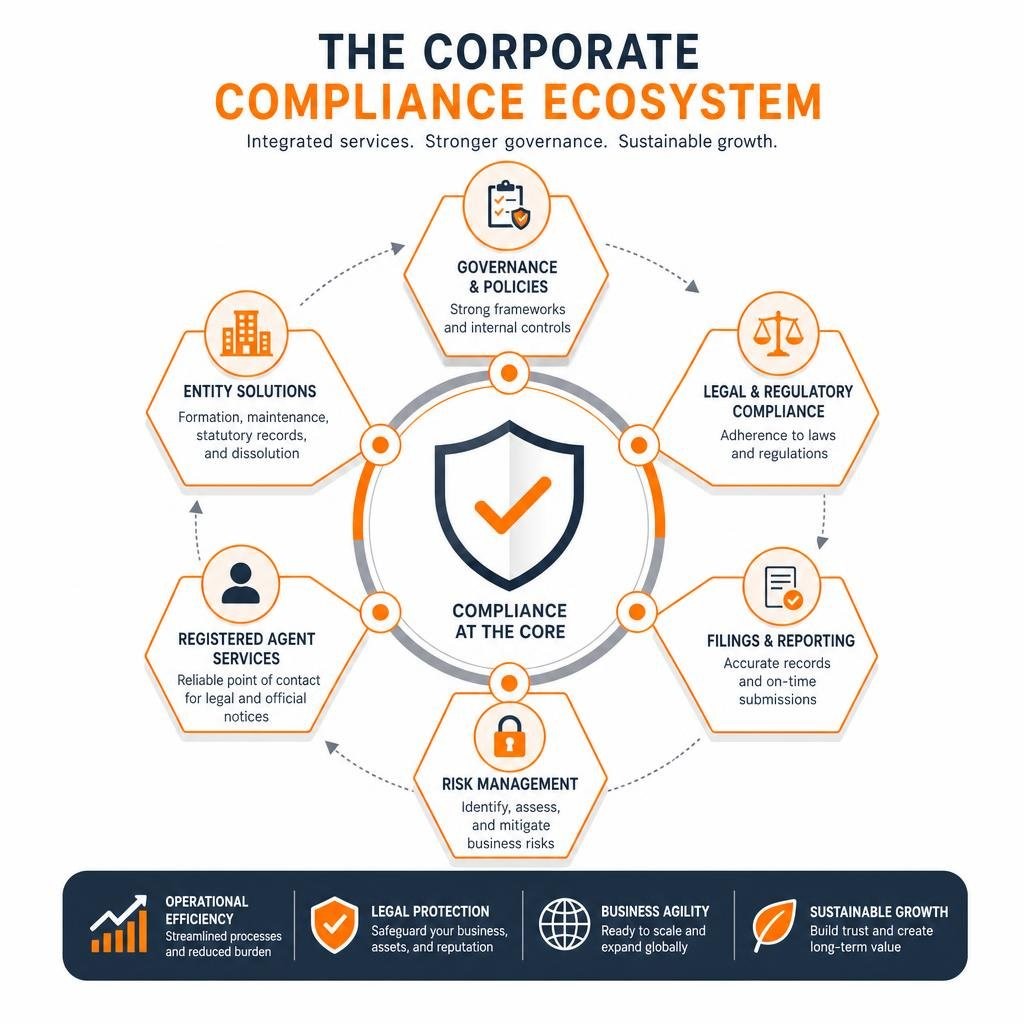
Understanding Corporate Services and Compliance
Corporate services and compliance represent the foundational infrastructure that allows businesses to operate legally, efficiently, and strategically in a dynamic global environment. Corporate services encompass a broad spectrum of administrative, legal, and financial support functions crucial for a company’s lifecycle, from inception to ongoing management and potential dissolution.
Compliance, on the other hand, refers to adhering to the myriad of laws, regulations, internal policies, and ethical standards that govern business operations. Together, they form an indispensable framework that helps businesses streamline their daily functions, ensure legal adherence, and foster sustainable growth by mitigating risks and optimizing resources.
The strategic value of these integrated services cannot be overstated. By centralizing documentation, automating routine tasks, and providing expert guidance, businesses can significantly reduce administrative burdens. This allows leadership to focus on core growth strategies and innovation, rather than getting bogged down in complex regulatory minutiae.
For instance, maintaining statutory records and submitting required filings accurately and on time is not merely a bureaucratic task; it’s a critical component of maintaining good standing and protecting the limited liability of owners. The proactive management of corporate services ensures operational agility, protects valuable assets, and facilitates seamless cross-border expansion in an increasingly interconnected world.
Core Pillars of Corporate Services
The landscape of corporate services is diverse, catering to various aspects of a business’s operational and legal needs. These core pillars include:
- Entity Solutions: This category covers the entire lifecycle of a legal entity, from incorporation and formation (e.g., LLCs, corporations) to ongoing maintenance, statutory record management, and eventual dissolution. It ensures that the legal structure of the business remains sound and up-to-date.
- Registered Agent Services: A registered agent is a designated point of contact for a business, responsible for receiving legal documents, government correspondence, and service of process. Maintaining a registered agent in every state or jurisdiction where a business operates is a fundamental compliance requirement, ensuring that critical legal notices are never missed.
- Business Administration and Compliance: This involves the day-to-day administrative tasks necessary to keep a business compliant. It includes managing corporate secretarial duties, processing amendments, handling reinstatements, and ensuring adherence to various state and federal reporting obligations. Many companies find that specialized providers offer comprehensive support for their corporate services compliance needs, ensuring all bases are covered.
- Fund Solutions: For investment funds, this involves specialized services such as fund administration, accounting, investor relations, and regulatory reporting tailored to the unique requirements of private equity, hedge funds, and other investment vehicles.
- Capital Markets Services:Supporting public and private capital transactions, these services include corporate trust, agency services for debt and equity offerings, and specialized support for mergers, acquisitions, and other complex financial transactions.
- Tax Solutions: Beyond basic tax preparation, this pillar includes comprehensive tax compliance, planning, and advisory services. It encompasses everything from ensuring adherence to local tax laws to navigating complex international tax regulations like FATCA/CRS and BEPS.
- Digital Brand Protection and Cyber Risk Management: In the July 2026 digital age, protecting a company’s online presence and intellectual property is paramount. This includes domain name management, online brand monitoring, enforcement against counterfeiting and infringement, and robust cybersecurity measures to safeguard sensitive data and systems.
The Strategic Value of Integrated Compliance
An integrated approach to corporate compliance offers significant strategic advantages. It’s not just about avoiding penalties; it’s about building a resilient, trustworthy, and efficient business.
- Risk Mitigation: By systematically identifying, assessing, and addressing compliance risks, companies can proactively prevent legal issues, financial penalties, and reputational damage. Effective compliance programs can reduce regulatory fines and reputational risk by up to 50% compared to those without structured programs, according to industry reports.
- Operational Consistency: A unified compliance framework ensures that all entities within a corporate structure, especially those operating across multiple jurisdictions, adhere to consistent standards. This reduces complexity and improves efficiency. Entities operating in 140+ jurisdictions, for example, require consistent compliance management to maintain good standing and avoid penalties across diverse regulatory environments.
- Centralized Documentation: Keeping all legal and compliance documentation in a single, accessible location simplifies audits, due diligence processes, and executive oversight. This centralization is crucial for large organizations with numerous subsidiaries or those engaged in frequent M&A activities. For effective tracking of corporate entities and their legal standing, many businesses leverage tools for corporate compliance EIN verification, ensuring all official identifiers are correctly managed.
- Cost Efficiency: While implementing robust compliance measures requires investment, the long-term cost savings are substantial. Avoiding fines, legal battles, and operational disruptions far outweighs the cost of proactive compliance. Furthermore, consolidating services with a single provider can lead to economies of scale.
- Regulatory Alignment: Staying abreast of rapidly evolving global regulations is a monumental task. Integrated compliance solutions ensure that a business remains aligned with current laws, whether they pertain to data privacy, anti-money laundering (AML), or economic substance rules.
- Transaction-Readiness: For companies considering mergers, acquisitions, or divestitures, a well-maintained compliance record and organized entity portfolio are invaluable. It streamlines due diligence, reduces deal friction, and increases the attractiveness of the business to potential investors or acquirers. Corporate health checks, often offered by service providers, can audit an entity portfolio for transaction-readiness, identifying and remediating any potential risks.
Internal and External Corporate Compliance Requirements
Maintaining compliance is a dual effort, requiring meticulous attention to both internal governance structures and external regulatory obligations. Both aspects are critical for upholding a company’s legal standing, protecting its limited liability, and ensuring operational integrity.

Internal Governance and Record-Keeping
Internal compliance requirements are the rules and procedures that govern a company’s internal operations and decision-making processes. These are largely self-imposed through foundational legal documents but are often mandated by state corporate laws.
- Bylaws/Operating Agreements:These are the foundational documents for corporations (bylaws) and LLCs (operating agreements). They outline the internal rules, responsibilities of officers and directors/managers, voting procedures, and other critical operational aspects. Maintaining updated bylaws or operating agreements is crucial, as they dictate how the company runs and makes decisions.
- Shareholder/Member Meetings:Corporations are typically required to hold annual shareholder and board of directors meetings. LLCs, while often having more flexibility, should also document significant member or manager decisions. These meetings are where key decisions are made, such as electing directors, approving financial statements, and amending bylaws.
- Board Resolutions: Formal decisions made by the board of directors or members/managers must be documented as resolutions. These provide a clear record of authorized actions, from opening bank accounts to approving major contracts.
- Stock Tracking/Membership Ledgers: Corporations must accurately track the issuance and transfer of stock, maintaining a stock ledger that records ownership. Similarly, LLCs need to track membership interests. This is vital for ownership verification, dividend distribution, and ensuring proper corporate governance.
- Meeting Minutes: Detailed minutes of all official meetings (shareholder, board, member, manager) must be kept. These minutes serve as the official record of discussions, decisions, and attendance, providing an audit trail for internal and external scrutiny.
- Audit Trails: Beyond meeting minutes, maintaining comprehensive audit trails for all significant corporate actions, financial transactions, and compliance activities is a best practice. This demonstrates accountability and transparency, which can be invaluable during regulatory inquiries or legal disputes.
Failure to adhere to these internal corporate services and compliance formalities can have severe consequences, including the “piercing of the corporate veil,” which could expose owners to personal liability.
External Regulatory Filings and Reporting
External compliance requirements are obligations imposed by government bodies at the federal, state, and local levels. These mandates ensure transparency, public safety, and fair business practices.
- Annual/Biennial Reports: Most states require corporations and LLCs to file annual or biennial reports with the Secretary of State or equivalent agency. These reports typically update basic company information, such as the registered agent, principal office address, and names of officers or directors. Non-compliance can lead to administrative dissolution.
- Franchise Taxes: Many states impose franchise taxes on businesses for the privilege of operating within their jurisdiction. These are often separate from income taxes and must be paid annually or biennially. Failure to pay can also result in loss of good standing or dissolution.
- Registered Agent Maintenance: As mentioned, maintaining a registered agent in every state where a business is formed or foreign-qualified is a continuous external requirement. This ensures that the company can reliably receive legal and official correspondence.
- Beneficial Ownership Information (BOI) Reporting: A significant federal requirement as of January 2024 (July 2026), the Corporate Transparency Act mandates that many U.S. and foreign-owned entities operating in the U.S. file Beneficial Ownership Information (BOI) reports with the Financial Crimes Enforcement Network (FinCEN). These reports disclose identifying information about the company’s beneficial owners and, for new entities, the company applicants. This is a critical component of anti-money laundering efforts.
- Initial Reports: Some states require an initial report to be filed shortly after incorporation or formation, providing initial details about the company’s structure and operations.
- Foreign Qualification: If a business expands its operations into a state other than where it was originally formed, it typically needs to “foreign qualify” in that new state. This involves registering with the Secretary of State and complying with that state’s specific requirements, including maintaining a registered agent there.
These external corporate services and compliance obligations are non-negotiable. Missing deadlines or failing to file accurately can lead to penalties, loss of good standing, and even administrative dissolution, effectively terminating the company’s legal existence.
Consequences of Non-Compliance and the Role of Leadership
The repercussions of failing to meet corporate services and compliance obligations can be severe, impacting a company’s financial health, operational continuity, and even the personal assets of its owners. Understanding these consequences underscores the critical importance of a robust compliance program.

The Cost of Regulatory Failure
Non-compliance is not merely an administrative oversight; it carries significant and often devastating costs.
- Fines and Penalties: Regulatory bodies impose substantial monetary fines for various compliance breaches. These can range from late filing fees for annual reports to multi-million dollar penalties for violations of anti-money laundering (AML), anti-bribery (FCPA), or data privacy regulations. For example, violations of the new Beneficial Ownership Information (BOI) reporting requirements can lead to civil penalties of up to $500 per day and criminal fines of up to $10,000, along with imprisonment for up to two years.
- Administrative Dissolution: Many states will administratively dissolve a company that repeatedly fails to file its annual reports or pay franchise taxes. This revokes the company’s legal status, rendering it unable to conduct business, enter contracts, or defend itself in court. Reinstatement can be a lengthy, costly, and uncertain process.
- Loss of Good Standing: Even before dissolution, a company can lose its “good standing” status. This can prevent it from obtaining loans, entering into new contracts, or expanding into new states. It signals to partners, investors, and clients that the company is not well-managed or reliable.
- Loss of Limited Liability Protection (Piercing the Corporate Veil):Perhaps the most severe consequence for owners of corporations and LLCs is the loss of limited liability protection. If a company fails to observe corporate formalities (e.g., holding meetings, keeping minutes, separating personal and business finances), a court may “pierce the corporate veil,” holding owners personally responsible for the company’s debts and liabilities. This negates the primary benefit of forming a separate legal entity.
- Reputational Damage: Beyond legal and financial penalties, non-compliance can severely damage a company’s reputation. Publicized regulatory actions, ethical lapses, or data breaches erode trust among customers, investors, and employees. Rebuilding a tarnished reputation can take years and significant investment.
- Asset Exposure: In cases of personal liability, the individual assets of owners, directors, or officers can be exposed to creditors or legal judgments, directly impacting their personal wealth.
Increased regulatory scrutiny and enforcement actions have made corporate compliance a top priority for legal, risk, and compliance leaders, as reported by RSM US. Even Top Silicon Valley leadersrecognize that strong governance and compliance are not just about avoiding penalties, but about building a resilient and trustworthy organization that can innovate and scale responsibly.
The Role of the Corporate Compliance Officer
Given the complexities and severe consequences associated with non-compliance, the role of a Corporate Compliance Officer (CCO) has become increasingly vital. A CCO is a senior executive responsible for overseeing and managing a company’s compliance program.
What a Corporate Compliance Officer Does: A CCO’s responsibilities are multifaceted and critical to a company’s ethical and legal operations:
- Program Design and Implementation: Developing, implementing, and maintaining an effective ethics and compliance program tailored to the company’s specific risks, industry, and operational footprint.
- Internal Controls: Establishing and monitoring internal controls to prevent and detect violations of laws, regulations, and internal policies.
- Monitoring and Testing:Continuously monitoring the effectiveness of the compliance program through audits, internal investigations, and data analytics.
- Benchmarking and Enhancement:Periodically evaluating and improving the compliance program over time, staying abreast of regulatory changes and industry best practices.
- Staff Training: Coordinating and delivering comprehensive compliance training programs to employees at all levels, ensuring they understand their obligations and the company’s ethical standards.
- Audit Facilitation: Acting as the primary liaison during internal and external compliance audits, ensuring timely and accurate information is provided.
- Strategic Decision-Making:Providing expert advice to leadership on compliance risks and implications related to new business initiatives, market entries, or product launches.
- Regulatory Reporting: Ensuring accurate and timely submission of all required regulatory reports.
When to Hire One: The decision to hire a dedicated CCO often depends on a company’s size, industry, complexity of operations, and risk profile.
- Growing Complexity: As an organization scales, particularly across multiple jurisdictions or into highly regulated industries (e.g., financial services, healthcare), the volume and complexity of compliance requirements grow exponentially.
- Increased Regulatory Scrutiny:Companies operating in environments with heightened regulatory enforcement or those that have experienced past compliance issues often need a CCO to demonstrate commitment to ethical conduct.
- Risk Mitigation: A CCO is crucial for companies facing significant legal, financial, or reputational risks. They help proactively identify and mitigate these risks before they escalate.
- Demonstrating “Tone at the Top”:Hiring a CCO, especially one with appropriate seniority and independence, signals to regulators, employees, and the public that the company is serious about compliance and ethical behavior.
- Managed Services Evolution: While smaller companies might initially rely on external legal counsel or managed compliance services, a dedicated CCO becomes essential when the internal need for strategic oversight, program integration, and continuous monitoring outweighs the benefits of purely outsourced solutions.
Some organizations may start by assigning compliance responsibilities to an existing executive, but as they scale, the demand for compliance officers continues to grow, necessitating a dedicated role or even a full compliance department.
Navigating Global Regulatory Trends and Technology
The global regulatory landscape is in a constant state of flux, driven by geopolitical shifts, technological advancements, and a growing emphasis on transparency and accountability. For multinational corporations, this means navigating a complex web of international laws and treaties, alongside local regulations. Fortunately, technology and managed services are evolving rapidly to help companies meet these challenges.
Evolving Global Regulatory Frameworks
Several key regulatory trends are shaping the corporate compliance environment in July 2026:
- Economic Substance Rules (ESR):Introduced in many offshore jurisdictions (e.g., Cayman Islands, BVI) since 2019, ESR require entities conducting specific “relevant activities” (e.g., banking, insurance, fund management, holding company business) to demonstrate genuine economic activity and physical presence within that jurisdiction. This means having adequate employees, premises, and operating expenses locally. These rules aim to combat harmful tax practices and ensure that entities are not merely shell companies.
- Automatic Exchange of Information (AEOI) – FATCA/CRS: The Foreign Account Tax Compliance Act (FATCA) and the Common Reporting Standard (CRS) mandate the automatic exchange of financial account information between participating jurisdictions. FATCA, a U.S. law, requires foreign financial institutions to report information about U.S. account holders to the IRS. CRS, a global standard developed by the OECD, requires financial institutions in participating jurisdictions to report information on non-resident account holders to their respective tax authorities, who then exchange this information with the account holders’ countries of residence. Non-compliance can lead to severe financial penalties and reputational damage.
- Base Erosion and Profit Shifting (BEPS) / Anti-Tax Avoidance Directive (ATAD): Initiated by the OECD and adopted by many countries, BEPS aims to prevent multinational enterprises from exploiting gaps and mismatches in tax rules to avoid paying taxes. The EU’s Anti-Tax Avoidance Directive (ATAD) translates many BEPS recommendations into binding law for EU member states, targeting aggressive tax planning schemes. These frameworks require companies to re-evaluate their international tax structures and transfer pricing policies.
- Mandatory Disclosure Rules (MDR):Following BEPS Action 12, many jurisdictions have implemented MDR (often inspired by the EU’s DAC6 directive). These rules require intermediaries (e.g., tax advisors, lawyers) and, in some cases, taxpayers themselves, to report potentially aggressive cross-border tax arrangements to tax authorities. This increases transparency and allows authorities to quickly identify and challenge tax avoidance schemes.
- ESG Reporting (Environmental, Social, and Governance): There’s a rapidly growing demand for companies to report on their ESG performance. This trend, driven by investors, regulators, and consumers, requires businesses to disclose information on their environmental impact, social responsibility (e.g., labor practices, diversity), and corporate governance. While still evolving, ESG reporting is becoming a critical component of corporate transparency and risk management, with frameworks like the Task Force on Climate-related Financial Disclosures (TCFD) gaining prominence.
Leveraging Technology and Managed Services
The complexity of these global regulatory trends makes technology and specialized managed services indispensable. Companies are increasingly turning to sophisticated platforms and expert providers to handle their corporate services and compliance needs.
- Compliance Platforms (e.g., Corpliance, Amiportal): These platforms offer secure online environments to manage compliance deadlines, store documents, and track entity information across multiple jurisdictions. Features often include customizable user permissions, built-in task calendars, and automated reminders for filings and renewals. This centralization is crucial for maintaining a global overview of corporate housekeeping.
- Automated Workflows: Technology can automate many routine compliance tasks, such as generating reports, tracking changes in beneficial ownership, and preparing documents for filing. This significantly reduces manual effort, minimizes errors, and ensures timely submissions.
- Centralized Coordination & Local Expertise: Global providers (like CSC, RSM, Appleby, Amicorp, RASi, Odyssey) offer integrated suites of corporate services across numerous jurisdictions. They combine centralized coordination and technology with local expertise to ensure compliance with country-specific requirements. This means a single point of contact can manage compliance across 180+ jurisdictions, for example, leveraging local specialists for nuanced legal, tax, and administrative tasks.
- Portfolio Audits and Corporate Health Checks: Many providers offer services to conduct in-depth audits of a company’s entire entity portfolio. These “corporate health checks” identify potential compliance gaps, assess transaction-readiness, and provide remediation plans. This proactive approach helps companies maintain good standing and mitigate risks before they escalate.
- Managed Services for Specific Functions: Beyond general entity management, managed services can cover specialized areas like registered agent services, global payroll, equity administration, and data privacy officer (DPO) support, particularly for companies expanding internationally without wanting to build out full in-house capabilities in every region. This allows companies to scale globally with confidence, knowing that country-specific requirements are being handled by experts.
Feature Traditional Compliance (Manual) Technology-Managed Compliance (Platform-based) Task Management Manual tracking, spreadsheets, disparate calendars Centralized task calendars, automated reminders, workflow automation Document Storage Physical files, shared drives, email attachments Secure online portals, version control, easy retrieval, audit trails VisibilityFragmented, difficult to get a holistic view of global compliance Real-time dashboards, global entity overview, consistent reporting Risk MitigationReactive, prone to human error, inconsistent application Proactive identification of deadlines, standardized processes, reduced errors Resource Use High manual effort, administrative burden on legal/finance teams Reduced administrative load, focus on strategic tasks, cost efficiency Global CoverageRequires managing multiple local providers and varying standards Single platform for multi-jurisdictional compliance, consistent application Data Analytics Limited insights, difficult to identify trends Data-driven insights, performance metrics, program effectiveness assessment Collaboration Email-based, manual sharing, potential for miscommunication Secure collaboration tools, customizable user permissions for internal/external teams Frequently Asked Questions about Corporate Compliance
Navigating the intricacies of corporate compliance often raises specific questions for business owners and executives. Here, we address some of the most common queries.
What is the difference between internal and external compliance?
Internal compliance refers to a company’s adherence to its own self-imposed rules, policies, and procedures, which are typically outlined in foundational documents like bylaws (for corporations) or operating agreements (for LLCs). It covers internal governance aspects such as holding regular board or member meetings, accurately recording meeting minutes, tracking stock or membership interests, and ensuring proper internal controls are in place. The goal is to maintain the integrity of the corporate structure and decision-making processes.
External compliance, on the other hand, involves fulfilling obligations imposed by external governmental bodies and regulatory agencies at the federal, state, and local levels. This includes filing annual reports, paying franchise taxes, maintaining a registered agent, and submitting specific disclosures like the Beneficial Ownership Information (BOI) report to FinCEN. External compliance ensures the company meets its legal duties to the public and regulatory authorities, maintaining its legal right to operate. Both are crucial for protecting limited liability and avoiding penalties.
What are the penalties for failing to file a Beneficial Ownership Information (BOI) report?
As of July 2026, the Corporate Transparency Act (CTA) mandates that many non-exempt entities file a Beneficial Ownership Information (BOI) report with the Financial Crimes Enforcement Network (FinCEN). Failure to comply with these requirements can result in significant penalties.
For each day a violation continues, there can be civil penalties of up to $500. Additionally, criminal penalties can include fines of up to $10,000 and imprisonment for up to two years. These penalties apply to both the reporting company and any individual who willfully provides false information or fails to report complete or updated beneficial ownership information. It is critical for all non-exempt entities to understand and adhere to these new federal reporting obligations.
How do economic substance regulations affect offshore entities?
Economic Substance Regulations (ESR), implemented in various offshore jurisdictions, require certain “relevant entities” conducting “relevant activities” to demonstrate genuine economic substance within that jurisdiction. This means the entity must not be a mere paper company but must have a tangible presence and conduct its core income-generating activities locally.
For an offshore entity, this generally means:
- Local Management: Having an adequate number of qualified employees physically present in the jurisdiction.
- Physical Presence: Maintaining appropriate premises or offices in the jurisdiction.
- Operating Expenses: Incurring adequate operating expenditure in the jurisdiction.
- Core Income-Generating Activities (CIGA): Conducting its primary business activities within the jurisdiction.
The specific requirements vary by jurisdiction and the type of relevant activity. Entities must typically make annual filings to confirm their compliance with the substance test. Failure to meet ESR can lead to significant penalties, including fines, spontaneous exchange of information with other tax authorities, and ultimately, strike-off from the corporate register. These regulations are a direct response to international efforts to combat tax avoidance and ensure that profits are taxed where economic value is created.
Conclusion
In the dynamic business landscape of July 2026, the strategic importance of robust corporate services and proactive compliance cannot be overstated. From meticulously managing internal governance documents to navigating the complexities of global regulatory trends like economic substance rules and ESG reporting, businesses face an ever-evolving set of challenges. The consequences of non-compliance—ranging from administrative dissolution and hefty fines to the piercing of the corporate veil—underscore the absolute necessity of a well-structured compliance program.
We’ve seen how integrating corporate services, leveraging advanced technology platforms, and engaging expert managed service providers can transform compliance from a burdensome obligation into a strategic advantage. By centralizing documentation, automating workflows, and benefiting from local expertise across multiple jurisdictions, companies can achieve operational excellence, mitigate risks, and free up valuable resources for innovation and growth.
Success in today’s global economy hinges on a company’s ability to maintain good standing, protect its assets, and uphold its reputation through unwavering adherence to legal and ethical standards. By embracing a proactive approach to corporate services and compliance, businesses can ensure sustainable growth, foster trust, and confidently navigate the complexities of the modern business world.


