Boosting Your Online Presence: A Guide to Digital Marketing for Small Businesses

Building Your Foundation: Strategy Before Tactics
Small businesses face big challenges in today’s digital world. But here’s the good news: digital marketing offers a powerful way to grow. It helps us connect with more customers, build our brand, and boost sales.
We know your customers are online. Internet usage has doubled over the past decade. This means having a strong online presence is no longer an option; it’s a must. Digital marketing helps us reach people exactly where they are, often more affordably than traditional advertising.
In this extensive guide, we will break down digital marketing for small businesses. We’ll define what it is and why it’s so vital for your success. We will also look at how it differs from traditional marketing, with a clear comparison table to guide us.
We will cover effective strategies like SEO, social media, and email marketing. We’ll also show you how to understand your audience, choose the right tools, and measure your campaigns. We will even explain the customer journey using a digital marketing funnel with an easy-to-understand infographic.
This guide is designed to empower you with the knowledge to thrive online. We want to help you boost your online presence and achieve your business goals.
Traditional vs. Digital Marketing: A Comparison
To truly appreciate the power of digital marketing, it’s helpful to understand how it contrasts with traditional marketing methods. While both aim to promote products or services, their approaches, reach, and measurability differ significantly.
Feature Traditional Marketing Digital Marketing Channels Print ads (newspapers, magazines), TV, radio, billboards, direct mail, flyers, telemarketing Websites, social media, email, search engines, mobile apps, online ads, video platforms Reach Often localized or broad but untargeted Global, highly targeted, and segmented Cost Can be high, especially for mass media Often more cost-effective, with scalable options Interactivity One-way communication Two-way communication, real-time engagement Measurement Difficult to track direct ROI (e.g., brand recognition, coupon redemption) Highly measurable (clicks, conversions, impressions, ROI) Audience Targeting Broad demographics Precise demographics, psychographics, behavior, intent Flexibility Slow to change campaigns Real-time adjustments and optimization Engagement Passive consumption Active participation and community building Digital marketing offers small businesses the agility and precision needed to compete effectively in today’s market.
The Digital Marketing Funnel: Guiding Your Customers
Understanding the customer journey is crucial for any marketing effort. The digital marketing funnel illustrates the stages a potential customer goes through, from first hearing about your business to becoming a loyal advocate. By tailoring your strategies to each stage, you can effectively guide them towards conversion.
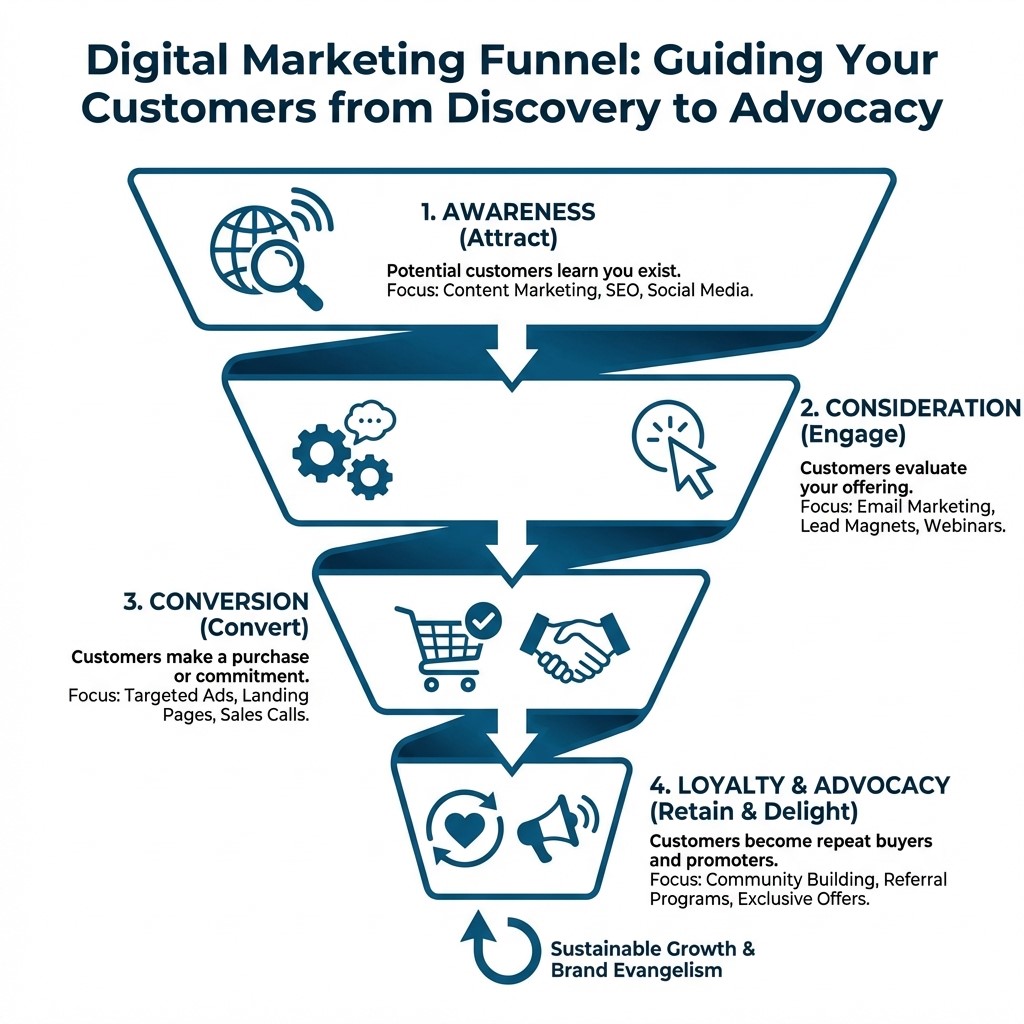
This funnel emphasizes that digital marketing is not just about making a sale, but building a relationship.
Before diving into specific digital marketing channels, lay a solid strategic foundation. Without clear goals and an understanding of your market, even the best tactics can fall flat. This foundational work ensures your efforts are focused, efficient, and ultimately, effective.
Our approach begins with setting SMART goals: Specific, Measurable, Achievable, Relevant, and Time-bound. For instance, instead of “get more customers,” a SMART goal might be “increase qualified leads by 15% through our website contact form within the next six months.” These clear objectives will guide every subsequent decision.
Next, we conduct thorough market research. This involves understanding industry trends, identifying market gaps, and learning about your potential customers. Digital tools make this easier than ever, allowing us to gather data on search behavior, online discussions, and competitor activities. This research helps us design marketing strategies based on a deep understanding of customer pain points, demographics, and the buyer journey.
Competitor analysis is another critical step. By examining what your competitors are doing well (and not so well) online, you can identify opportunities and differentiate your brand. Look at their websites, social media presence, content, and even their paid ad strategies. This insight can help you carve out your own unique space.
Finally, articulating your Unique Selling Proposition (USP) is paramount. What makes your small business special? Why should customers choose you over others? Your USP should highlight what sets you apart, whether it’s exceptional customer service, a unique product feature, or a specific niche you serve. This clarity will resonate throughout all your digital marketing messages. For many small businesses, building a strong online presence is a continuous journey that benefits from a well-thought-out strategy from the start.
Understanding Your Target Audience
Effective digital marketing hinges on a deep understanding of who you’re trying to reach. This goes beyond basic demographics; it’s about creating detailed buyer personas. A buyer persona is a semi-fictional representation of your ideal customer, based on market research and real data about your existing customers. It includes their demographics (age, location, income), psychographics (interests, values, lifestyle), behaviors (online habits, purchasing patterns), and most importantly, their pain points and challenges.
By understanding your audience’s pain points, you can tailor your messaging to offer solutions. Knowing their online habits helps you choose the most effective channels to reach them. For example, if your target audience spends most of their time on Instagram, that’s where your social media efforts should be concentrated.
Mapping the customer journey for each persona helps you understand the different touchpoints they interact with your brand, from initial awareness to post-purchase support. This allows you to create relevant content and experiences at every stage. We can use tools like surveys (e.g., Google Forms, SurveyMonkey), social media analytics, and website analytics (Google Analytics) to gather these insights. Direct customer feedback is also invaluable.

The Role of a Website in Small Business Digital Marketing
Your website is often the central hub of your digital marketing efforts – your online storefront, information center, and conversion engine all rolled into one. For small businesses, having a visually appealing and conversion-optimized website is non-negotiable.
First and foremost, your website must be mobile-first designed. With over 60% of online activity happening on mobile devices, a site that doesn’t perform well on smartphones and tablets will alienate a significant portion of your audience. This means fast loading times, easy navigation, and a responsive design that adapts to any screen size.
User experience (UX) is critical. A positive UX means visitors can easily find what they’re looking for, understand your offerings, and complete the actions they want without frustration. This includes clear navigation, readable fonts, and an intuitive layout.
Conversion rate optimization (CRO) focuses on turning website visitors into customers or leads. This involves strategically placing clear calls-to-action (CTAs) – buttons or links that prompt visitors to “Buy Now,” “Sign Up,” “Get a Quote,” or “Learn More.” Every page should have a purpose and guide the user towards a conversion goal.
Incorporating social proof is also highly effective. Customer testimonials, reviews, case studies, and trust badges build credibility and reassure potential buyers. Platforms like WordPress and Shopify offer plugins and apps (like Yotpo and Pixlee) to easily integrate customer reviews, including pictures and videos, directly onto your product pages.
Choosing the right website platform (like WordPress or Shopify) depends on your business needs, but the focus should always be on functionality, scalability, and ease of use for both you and your customers. Your website is an investment that pays dividends when optimized correctly, and services like ForeFront Web Small Business Digital Marketing can help ensure it’s built for success.
Core Small Business Digital Marketing Strategies
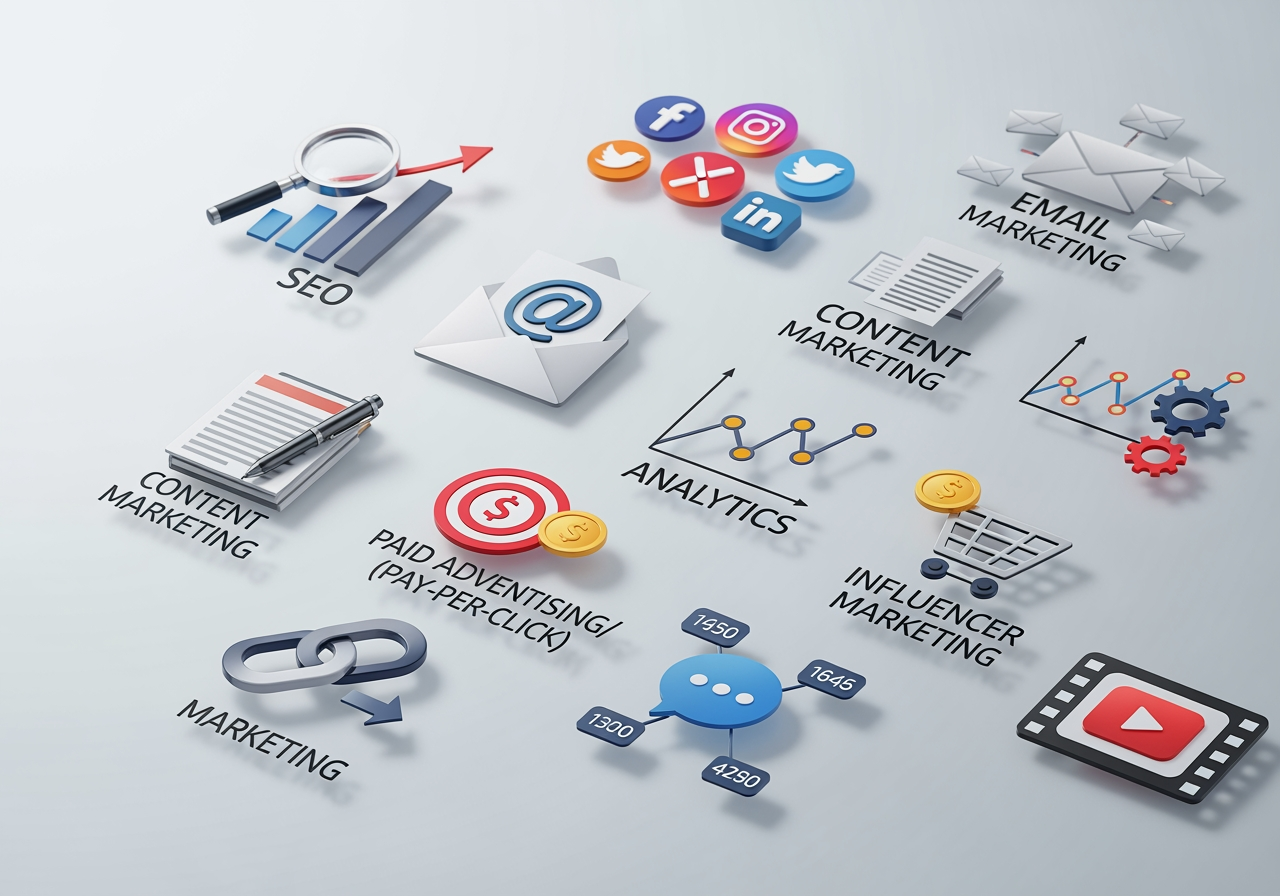
A sound digital marketing strategy is not one-dimensional; it’s multifaceted. It involves blending various services together for a well-oiled machine. Each channel plays a unique role, but their combined impact is what drives significant growth. The key is to select the channels that best align with your business goals and target audience, and then allocate your budget effectively.
Search Engine Optimization (SEO): Getting Found on Google
Search Engine Optimization (SEO) is the process of improving your website’s visibility on search engines like Google. For small businesses, effective SEO means appearing higher in search results when potential customers look for products or services you offer. This is crucial because higher rankings often lead to more website traffic, which can translate into more leads and sales.
On-page SEO involves optimizing elements directly on your website, such as title tags, meta descriptions, headings, and image alt text. It also includes ensuring your website content is high-quality, relevant, and well-structured.
Keyword research is the foundation of any strong SEO strategy. It involves identifying the words and phrases your target audience uses when searching for information related to your business. By incorporating these keywords naturally into your website content, you signal to search engines that your site is relevant to those queries.
Beyond keywords, content quality is paramount. Google prioritizes websites that offer valuable, comprehensive, and trustworthy information. This means creating content that genuinely answers user questions and provides solutions. Understanding user intent – what a searcher is truly looking for – helps you create content that satisfies their needs.
Link building, the process of acquiring hyperlinks from other websites to your own, is another critical component. These backlinks act as “votes of confidence” from other sites, signaling to search engines that your content is authoritative and trustworthy.
Leveraging Local SEO for Geographic Targeting
For many small businesses, especially those with physical locations or serving a specific geographic area, local SEO is a secret weapon. It’s about optimizing your online presence to attract customers in your immediate vicinity. Imagine someone searching “best coffee shop near me” – local SEO ensures your business appears at the top of those results.
A cornerstone of local SEO is your Google Business Profile (GBP). Claiming and optimizing your GBP with accurate business information (name, address, phone number – often referred to as NAP), hours of operation, photos, and customer reviews is vital. Regularly updating this profile helps Google better understand and prominently display your business in local search results and on Google Maps. Many small businesses are not taking full advantage of this powerful tool. By optimizing their websites for local searches, small businesses can ensure they appear at the top of search results and in Google’s Map Pack. You can learn more about local SEO tactics and how they help build reputation and establish local expertise by visiting resources like Outpace SEO.
Beyond GBP, localized keywords are essential. Think about how customers might search for your services specifically in your area (e.g., “plumber in Miami,” “bakery near downtown”). Incorporate these into your website content and GBP.
Distributing your business information through online directories (Yelp, Yellow Pages, etc.) and ensuring NAP consistency across all platforms reinforces your local presence for search engines. Finally, encouraging and responding to customer reviews on your GBP and other review sites significantly boosts your local SEO and builds trust.
Content Marketing: Building Trust and Authority
Content marketing is about creating and distributing valuable, relevant, and consistent content to attract and retain a clearly defined audience — and ultimately drive profitable customer action. For small businesses, it’s an incredibly effective way to build brand awareness, establish expertise, and foster customer loyalty without relying solely on direct sales pitches.
This strategy encompasses various formats:
- Blogging: Regularly publishing blog posts on topics relevant to your industry and audience helps you rank for keywords, provide value, and drive traffic to your website. It’s a great way to answer common customer questions and demonstrate your knowledge.
- Video Marketing: As a powerful and engaging medium, video content is increasingly important. Research shows that 89% of customers want to see more videos from brands this year. Short-form videos (like those on TikTok and Instagram Reels) are particularly effective for capturing attention and conveying quick messages. Longer videos can be used for tutorials, behind-the-scenes glimpses, or in-depth explanations. AI video generators such as Synthesia and Veed.io, and editing apps like Canva, can simplify the creation process.
- E-books and Whitepapers: Offering downloadable, in-depth guides can position your business as a thought leader and serve as valuable lead magnets.
- Case Studies: Showcasing how your products or services have helped real customers provides compelling social proof and demonstrates your value proposition.
By consistently creating content that answers customer questions, solves their problems, and educates them, you establish your business as a trusted resource. This approach naturally attracts customers who are already interested in what you offer, making the sales process more organic and effective.
Social Media Marketing: Engaging Your Community
Social media platforms are where a significant portion of your target audience spends their time online. For small businesses, social media marketing is about connecting with customers, building community, and driving engagement. It’s not just about broadcasting messages; it’s about fostering two-way conversations.
First, platform selection is key. You don’t need to be everywhere. Focus on the platforms where your target audience is most active. For instance, 42% of Americans use social media platforms to find new small businesses, highlighting its importance.
- Facebook: Remains a dominant platform for broad reach and community building. Video content often performs best.
- Instagram: Ideal for visually driven businesses, with features like Reels, Stories, and Carousel posts that are highly engaging. For B2B, creating a LinkedIn page for your business can be highly effective for professional networking and lead generation.
- YouTube: Essential for video content, tutorials, and building a visual brand presence. You’ll need a Google account first, then use it to create your YouTube account.
- TikTok: Dominant for short-form, authentic video content, especially with younger demographics.
- Pinterest: Great for visual discovery and e-commerce, particularly for female audiences with high buyer intent.
Content types should vary, but prioritize what resonates with your audience. This could include behind-the-scenes glimpses, user-generated content, polls, Q&As, and educational snippets. Engagement strategies involve actively responding to comments and messages, running contests or challenges, and humanizing your brand through storytelling. The goal is to build a loyal community around your brand.
Email Marketing: Nurturing Leads and Customers
Email marketing remains one of the most effective and cost-efficient digital marketing strategies for small businesses. It allows for direct, personalized communication with your audience, fostering relationships and driving repeat business. In fact, 81% of small- and medium-sized business professionals believe that email marketing increases customer retention and helps acquire new customers.
The first step is list building. You need to ethically collect email addresses from interested individuals. This can be done through:
- Lead Magnets: Offering something valuable for free in exchange for an email address, such as an e-book, a discount code, a free consultation, or exclusive content.
- Website Sign-Up Forms: Prominently placed forms on your website, blog, or landing pages.
- In-Store Sign-Ups: For brick-and-mortar businesses, collecting emails at the point of sale.
Once you have a list, segmentation is crucial. Dividing your audience into smaller groups based on interests, purchase history, or demographics enables you to send highly targeted, relevant messages.
Nurture sequences are automated series of emails designed to guide subscribers through the customer journey, from initial interest to purchase and beyond. These can include welcome series, educational content, product highlights, and special offers. Regular newsletters keep your audience informed and engaged with your brand.
The benefits are clear: email marketing helps you stay top-of-mind, promote new products or services, drive traffic to your website, and build strong customer relationships that lead to loyalty and referrals.
Paid Advertising: When and How to Invest
While organic strategies like SEO and content marketing build long-term presence, paid advertising offers immediate visibility and highly targeted reach. For small businesses, paid ads can be a powerful tool for generating leads, driving sales, and quickly testing marketing messages.
You should consider paid advertising when you need:
- Immediate Results: Unlike SEO, which takes time, paid ads can deliver traffic and conversions almost instantly.
- Targeted Reach: Paid platforms allow for incredibly precise targeting based on demographics, interests, behaviors, and even specific keywords.
- Scalability: Once a campaign is performing well, you can often scale your budget to reach more people and generate more results.
- Testing: Paid ads are excellent for A/B testing headlines, images, and calls to action to see what resonates most with your audience.
Different types of digital ads include:
- PPC/Search Ads: These appear at the top of search engine results pages (SERPs) when users search for specific keywords. Platforms like Google Ads allow you to bid on keywords relevant to your business, ensuring your ad is seen by users with high commercial intent.
- Social Media Ads: Platforms like Facebook, Instagram, LinkedIn, and TikTok offer robust advertising options. These ads appear in users’ feeds and can be highly targeted based on extensive user data, making them ideal for brand awareness, lead generation, and direct sales.
- Display Ads: These are visual ads (banners, images) that appear on websites across the internet, often part of a larger ad network. They are great for brand awareness and retargeting.
- Retargeting (or Remarketing): This strategy shows ads to users who have previously interacted with your website or social media profiles. It’s highly effective because you’re targeting individuals who already know your brand, increasing the likelihood of conversion.
Investing in paid advertising allows you to control your messaging and reach specific audiences quickly. For businesses exploring different lead-generation strategies, paid advertising can offer a direct, measurable path to attracting new customers.
Measuring Success and Adapting Your Approach
One of the greatest advantages of digital marketing over traditional methods is its measurability. For small businesses, understanding what’s working (and what isn’t) is crucial for optimizing efforts and maximizing return on investment (ROI).
We track Key Performance Indicators (KPIs) to evaluate the effectiveness of our campaigns. These metrics vary depending on your goals, but commonly include:
- Website Traffic: How many visitors come to your site? Where do they come from (traffic sources)?
- Conversion Rates: What percentage of visitors complete a desired action (e.g., make a purchase, fill out a form, download an e-book)?
- Engagement Metrics: For social media, this includes likes, shares, comments, and reach. For email, it’s open rates and click-through rates.
- Lead Generation: How many new leads are you acquiring? What is the cost per lead?
- Customer Acquisition Cost (CAC): How much does it cost to acquire a new customer?
- Return on Ad Spend (ROAS): For paid campaigns, how much revenue is generated for every dollar spent on ads?
Tools like Google Analytics provide comprehensive insights into website traffic, user behavior, and conversions. By installing a tracking code on your website, you can access data on traffic sources, user demographics, and conversion rates. For social media, most platforms offer free built-in analytics tools (e.g., Facebook Insights, X Analytics, LinkedIn Analytics) to track engagement and audience demographics.
Calculating ROI involves comparing the cost of your marketing campaigns to the revenue generated. This gives you a clear picture of how well your initiatives are paying off. For example, if you spend $100 on an ad campaign that results in $500 in sales, your ROI is positive.
A/B testing is a powerful technique for optimizing campaigns. This involves creating two versions of an ad, email, or landing page (A and B) and showing them to different segments of your audience to see which performs better. This data-driven approach allows for continuous improvement.
Finally, the online landscape is constantly evolving. Adapting to trends such as AI-powered personalization, the rise of zero-click searches, the dominance of short-form video, and the shift to first-party data (due to Google’s phasing out of third-party cookies in 2025) is vital. Regularly analyzing your data and being willing to adjust your strategies ensures your digital marketing remains effective and competitive.
Frequently Asked Questions about Small Business Digital Marketing
Navigating digital marketing can bring up many questions for small business owners. Here, we address some of the most common ones.
How much should a small business spend on digital marketing?
There’s no one-size-fits-all answer, as it depends on your industry, goals, and current revenue. However, a common guideline suggests that small businesses typically allocate between 7-12% of their gross revenue to marketing. For new businesses or those aiming for aggressive growth, this percentage might be higher.
The best approach is to start small, test different channels, and scale up what works. Focus on ROI: if an investment in digital marketing brings in more revenue than it costs, it’s a worthwhile expense. Industry benchmarks can also provide a starting point, but always tailor your budget to your specific circumstances and measurable objectives.
Which digital marketing strategy is best for my business?
The “best” strategy is the one that aligns most closely with your business type, target audience, and goals.
- For B2C (Business-to-Consumer) companies, especially those with lower price points or simpler sales funnels, higher-funnel channels such as social media marketing (Instagram, TikTok) and paid social advertising are often highly effective.
- For B2B (Business-to-Business) companies with niche audiences and longer sales cycles, strategies like LinkedIn marketing, paid search advertising (Google Ads), content marketing, and email marketing tend to yield better results.
- Service-based businesses often benefit greatly from local SEO, content marketing that demonstrates expertise, and strong customer reviews.
- Product-based businesses (e-commerce) can leverage visual social media, influencer marketing, email marketing, and targeted paid ads.
The goal is to choose channels where your target audience spends their time and where you can effectively communicate your unique value proposition.
How long does it take to see results from digital marketing?
The timeline for seeing results varies significantly by strategy:
- Paid Advertising (PPC, Social Ads): You can often see results (traffic, leads, sales) almost immediately, sometimes within days or weeks of launching a campaign. This makes it excellent for quick boosts or testing.
- Social Media Marketing: While engagement can be immediate, building a substantial following and driving consistent leads takes several months of consistent effort.
- Email Marketing: List building takes time, but once you have an engaged audience, email campaigns can generate results quickly.
- SEO (Search Engine Optimization): This is a long-term strategy. It typically takes 3-6 months to start seeing noticeable improvements in organic rankings and traffic, and often 6-12 months or more for significant results, especially for competitive keywords.
It’s crucial to set realistic expectations. Digital marketing is not a magic bullet; it requires consistent effort, patience, and continuous optimization. Celebrate small wins along the way, but understand that sustainable growth takes time.
Conclusion: Your Next Steps to Online Growth
Starting on your digital marketing journey for your small business can seem daunting, but the opportunities for growth are immense. We’ve explored what digital marketing is, why it’s indispensable for small businesses in today’s online-first world, and how it differs from traditional approaches. We’ve also dug into key strategies like SEO, social media, email marketing, and paid advertising, alongside the importance of understanding your audience and measuring your success.
The most important takeaway is the importance of consistency and a strategic, data-driven approach. Don’t try to do everything at once. Instead, start with a few key actions that align with your business goals and resources.
Here are some actionable first steps to boost your online presence:
- Claim and Optimize Your Google Business Profile: This is foundational for local visibility.
- Choose One or Two Social Media Channels: Focus your efforts where your target audience is most active and where you can consistently create engaging content.
- Set Up Google Analytics: Begin tracking your website performance to understand your audience and the effectiveness of your campaigns.
- Start Building an Email List: Implement a simple lead magnet on your website to begin capturing valuable customer contacts.
- Define Your Unique Selling Proposition (USP): Clearly articulate what makes your business special and weave it into all your messaging.
For small businesses seeking to steer this complex landscape, finding affordable small business digital marketing support can provide the expertise and guidance needed to implement these strategies effectively. Embracing continuous learning and adaptation will ensure your business remains agile and competitive in the ever-changing online landscape. The digital world is waiting for your small business to shine – take these steps and open up your full potential.
Explore More Digital Marketing Resources:
- Explore resources like BullsEye Pay Per Lead Lawyers to learn about effective strategies for generating leads.
- Find how to optimize your website with an SEO audit.
- Understand the benefits of retargeting ads for your campaigns.
- Get a free consultation to discuss your specific digital marketing needs.