Driving Growth with Advanced SEO and AI Search Optimization
Integrating Digital Marketing and SEO for Maximum Reach
The digital landscape is always shifting. In June 2026, staying visible online is more complex than ever. Search engines are constantly evolving. New AI technologies are changing how people find information. Businesses that adapt thrive, while others struggle to be seen.
We understand these challenges. Mastering online visibility requires a deep understanding of both traditional digital marketing and cutting-edge search engine optimization (SEO). It means combining proven strategies with forward-thinking approaches.
This extensive guide will explore how to navigate this new era. We will clarify the differences between digital marketing and SEO. We’ll explain why organic search remains crucial for growth. You’ll learn how search engines work and discover the core pillars of an effective SEO strategy. We’ll also cover the latest trends, including AI’s impact on search. Finally, we’ll show you how to measure your success.
Our goal is to provide you with the knowledge needed to drive real business growth.
Digital marketing encompasses a broad spectrum of online activities designed to promote products or services. It includes everything from social media campaigns and email marketing to paid advertising and search engine optimization. While all these components contribute to a robust digital presence, search engine optimization (SEO) plays a unique and foundational role. It’s about ensuring your business is found when potential customers are actively searching for solutions, driving organic traffic that often translates into higher conversion rates and lower customer acquisition cost over time.
The Core Differences Between Traditional Digital Marketing and SEO
Traditional digital marketing often involves paid media, such as pay-per-click (PPC) ads, display ads, and social media advertising. These methods offer immediate visibility and can be highly effective for specific campaigns or rapid brand awareness initiatives. However, their visibility ceases the moment the ad spend stops.
SEO, by contrast, focuses on organic search results. It’s the process of optimizing your website and its content to rank higher in search engines like Google, without paying for the clicks. While traditional digital marketing can provide quick bursts of traffic, SEO builds sustainable, long-term visibility. For instance, a comprehensive digital strategy might leverage paid ads for immediate impact while simultaneously investing in a robust SEO plan to secure enduring online presence. For businesses seeking a holistic approach that blends immediate results with sustained growth, exploring options for Results-driven digital marketing SEOcan be highly beneficial, ensuring all online efforts are synchronized for maximum impact.
The key distinction lies in the investment and longevity. Paid campaigns require continuous financial outlay, while SEO is an ongoing investment of time and expertise that yields compounding returns. Both are vital, but they serve different strategic purposes within the broader digital marketing ecosystem.
Why Organic Search is the Ultimate Growth Engine
Organic search is not just another traffic source; it’s a powerful engine for sustainable business growth. Its importance stems from several key advantages:
- Exceptional ROI: For every dollar spent on SEO, businesses earn an average of over $22. This impressive return on investment highlights its cost-effectiveness compared to many other marketing channels.
- Reduced Customer Acquisition Costs: By improving your site’s organic search traffic, businesses can significantly reduce their customer acquisition costs, sometimes by as much as 87%. This efficiency makes growth more sustainable.
- High-Quality Traffic: Users actively searching for products, services, or information are typically further down the purchase funnel or highly engaged with a topic. This translates to higher conversion rates from organic visitors.
- Enhanced Brand Equity and Trust: Ranking high in organic search results builds credibility and authority. Users inherently trust organic listings more than paid ads, associating top results with expertise and reliability.
- Long-Term, Compounding Growth: Unlike paid ads that stop delivering traffic when the budget runs out, SEO efforts accumulate over time. A well-optimized site continues to attract visitors long after the initial work is done, creating a compounding effect on traffic and leads.
- Ubiquitous Presence: With Google processing over 8.5 billion searches every day, and 58% of online searches coming from mobile devices, being visible in organic search is essential for reaching a vast audience.
- Competitive Edge: The first organic search result on Google receives 27.6% of clicks, and 69% of clicks go to the first 5 organic search results for any keyword. Dominating these top positions gives businesses a significant advantage over competitors.
Organic Search Benefits:
- Increased Visibility: Appear prominently when customers search.
- Higher Trust: Perceived as more credible than paid ads.
- Sustainable Traffic: Continuous flow of visitors without ongoing ad spend.
- Better ROI: High return on investment over the long term.
- Lower CAC: Significantly reduces the cost of acquiring new customers.
- Enhanced User Experience: Optimization for search engines often improves site usability.
- Market Insights: Keyword data reveals customer needs and preferences.
- Brand Authority: Establishes your business as an industry leader.
For businesses looking to build a resilient online presence, investing in robust SEO Services in Kansas City is not just an option, but a strategic imperative.
The Mechanics of Modern Search: Crawling, Indexing, and Ranking
To truly master SEO, it’s crucial to understand how search engines operate. While the exact algorithms are closely guarded secrets, the fundamental process of how search engines discover, organize, and present information remains consistent. This process involves three core stages: crawling, indexing, and ranking.

How Google Processes Web Pages in 2026
Google, as the dominant search engine, uses sophisticated programs called Googlebot (or web crawlers) to explore the internet. This crawling process involves following links from page to page, discovering new content, and identifying updates to existing pages. An XML sitemap acts as a roadmap for these crawlers, guiding them to all important pages on your site and ensuring they don’t miss anything crucial.
Once a page is crawled, it moves to the indexing phase. During indexation, Google analyzes the content of the page—text, images, videos, and other media—to understand its topic and relevance. It then stores this information in its massive index, a vast database of all the web pages it has discovered. Modern search engines also focus heavily on rendering, meaning they execute JavaScript and CSS just like a user’s browser would, to fully understand the page’s layout and content. This ensures that dynamic, interactive web pages are indexed accurately. For a deeper dive into how these updates impact your strategy, staying informed on Everything You Need to Know About Google’s New Algorithm Update is essential.
Finally, when a user enters a query, Google’s ranking algorithms spring into action. These complex algorithms evaluate hundreds of factors to determine which pages from its index are most relevant and authoritative for that specific search query. Factors include content quality, keyword relevance, user experience, site speed, mobile-friendliness, and the number and quality of backlinks, among many others. The goal is always to provide the most helpful and accurate results to the user.
The Shift from Keyword Matching to Semantic Intent
In the early days of SEO, simply stuffing keywords into content was often enough to rank. Today, search engines are far more sophisticated. The shift has been from basic keyword matching to understanding semantic intent—the underlying meaning and context behind a user’s query.
This evolution is driven by advancements in artificial intelligence and natural language processing. Search engines now analyze conversational queries, anticipating what a user truly wants to find, even if their exact words aren’t present on the page. They categorize user intent into types like:
- Informational: Users seeking answers to questions (e.g., “What is SEO?”). These account for a significant portion of searches, with 52.65% of Google searches being informational.
- Navigational: Users looking for a specific website or brand (e.g., “CreatiVertical homepage”).
- Commercial Investigation: Users researching products or services before making a purchase (e.g., “best digital marketing agency reviews”).
- Transactional: Users ready to buy or complete an action (e.g., “buy SEO services online”).
Understanding these nuances of searcher behavior is critical. Content must be created not just to include keywords, but to thoroughly address the user’s intent, providing comprehensive and valuable information that satisfies their underlying need.
The Four Pillars of a High-Performance Search Strategy
An effective SEO strategy is built upon multiple interconnected components, often referred to as the “pillars.” These pillars work in harmony to ensure your website is discoverable, authoritative, and provides an excellent user experience.
| Pillar | Focus | Key Activities “` The digital landscape is always shifting. In June 2026, staying visible online is more complex than ever. Search engines are constantly evolving. New AI technologies are changing how people find information. Businesses that adapt thrive, while others struggle to be seen.
We understand these challenges. Mastering online visibility requires a deep understanding of both traditional digital marketing and cutting-cutting edge search engine optimization (SEO). It means combining proven strategies with forward-thinking approaches.
This extensive guide will explore how to navigate this new era. We will clarify the differences between digital marketing and SEO. We’ll explain why organic search remains crucial for growth. You’ll learn how search engines work and discover the core pillars of an effective SEO strategy. We’ll also cover the latest trends, including AI’s impact on search. Finally, we’ll show you how to measure your success.
Our goal is to provide you with the knowledge needed to drive real business growth.
Integrating Digital Marketing and SEO for Maximum Reach
Digital marketing encompasses a broad spectrum of online activities designed to promote products or services. It includes everything from social media campaigns and email marketing to paid advertising and search engine optimization (SEO). While all these components contribute to a robust digital presence, SEO plays a unique and foundational role. It’s about ensuring your business is found when potential customers are actively searching for solutions, driving organic traffic that often translates into higher conversion rates and lower customer acquisition cost over time.
The Core Differences Between Traditional Digital Marketing and SEO
Traditional digital marketing often involves paid media, such as pay-per-click (PPC) ads, display ads, and social media advertising. These methods offer immediate visibility and can be highly effective for specific campaigns or rapid brand awareness initiatives. However, their visibility ceases the moment the ad spend stops.
SEO, by contrast, focuses on organic search results. It’s the process of optimizing your website and its content to rank higher in search engines like Google, without paying for the clicks. While traditional digital marketing can provide quick bursts of traffic, SEO builds sustainable, long-term visibility. For instance, a comprehensive digital strategy might leverage paid ads for immediate impact while simultaneously investing in a robust SEO plan to secure enduring online presence. For businesses seeking a holistic approach that blends immediate results with sustained growth, exploring options for Results-driven digital marketing SEO can be highly beneficial, ensuring all online efforts are synchronized for maximum impact.
The key distinction lies in the investment and longevity. Paid campaigns require continuous financial outlay, while SEO is an ongoing investment of time and expertise that yields compounding returns. Both are vital, but they serve different strategic purposes within the broader digital marketing ecosystem.
Why Organic Search is the Ultimate Growth Engine
Organic search is not just another traffic source; it’s a powerful engine for sustainable business growth. Its importance stems from several key advantages:
- Exceptional ROI: For every dollar spent on SEO, businesses earn an average of over $22. This impressive return on investment highlights its cost-effectiveness compared to many other marketing channels.
- Reduced Customer Acquisition Costs: By improving your site’s organic search traffic, businesses can significantly reduce their customer acquisition costs, sometimes by as much as 87%. This efficiency makes growth more sustainable.
- High-Quality Traffic: Users actively searching for products, services, or information are typically further down the purchase funnel or highly engaged with a topic. This translates to higher conversion rates from organic visitors.
- Enhanced Brand Equity and Trust: Ranking high in organic search results builds credibility and authority. Users inherently trust organic listings more than paid ads, associating top results with expertise and reliability.
- Long-Term, Compounding Growth: Unlike paid ads that stop delivering traffic when the budget runs out, SEO efforts accumulate over time. A well-optimized site continues to attract visitors long after the initial work is done, creating a compounding effect on traffic and leads.
- Ubiquitous Presence: With Google processing over 8.5 billion searches every day, and 58% of online searches coming from mobile devices, being visible in organic search is essential for reaching a vast audience.
- Competitive Edge: The first organic search result on Google receives 27.6% of clicks, and 69% of clicks go to the first 5 organic search results for any keyword. Dominating these top positions gives businesses a significant advantage over competitors.
Organic Search Benefits:
- Increased Visibility: Appear prominently when customers search.
- Higher Trust: Perceived as more credible than paid ads.
- Sustainable Traffic: Continuous flow of visitors without ongoing ad spend.
- Better ROI: High return on investment over the long term.
- Lower CAC: Significantly reduces the cost of acquiring new customers.
- Enhanced User Experience: Optimization for search engines often improves site usability.
- Market Insights: Keyword data reveals customer needs and preferences.
- Brand Authority: Establishes your business as an industry leader.
For businesses looking to build a resilient online presence, investing in robust SEO Services in Kansas City is not just an option, but a strategic imperative.
The Mechanics of Modern Search: Crawling, Indexing, and Ranking
To truly master SEO, it’s crucial to understand how search engines operate. While the exact algorithms are closely guarded secrets, the fundamental process of how search engines discover, organize, and present information remains consistent. This process involves three core stages: crawling, indexing, and ranking.
How Google Processes Web Pages in 2026
Google, as the dominant search engine, uses sophisticated programs called Googlebot (or web crawlers) to explore the internet. This crawling process involves following links from page to page, discovering new content, and identifying updates to existing pages. An XML sitemap acts as a roadmap for these crawlers, guiding them to all important pages on your site and ensuring they don’t miss anything crucial.
Once a page is crawled, it moves to the indexing phase. During indexation, Google analyzes the content of the page—text, images, videos, and other media—to understand its topic and relevance. It then stores this information in its massive index, a vast database of all the web pages it has discovered. Modern search engines also focus heavily on rendering, meaning they execute JavaScript and CSS just like a user’s browser would, to fully understand the page’s layout and content. This ensures that dynamic, interactive web pages are indexed accurately. For a deeper dive into how algorithm updates impact your strategy, staying informed on Everything You Need to Know About Google’s New Algorithm Update is essential.
Finally, when a user enters a query, Google’s ranking algorithms spring into action. These complex algorithms evaluate hundreds of factors to determine which pages from its index are most relevant and authoritative for that specific search query. Factors include content quality, keyword relevance, user experience, site speed, mobile-friendliness, and the number and quality of backlinks, among many others. The goal is always to provide the most helpful and accurate results to the user.
The Shift from Keyword Matching to Semantic Intent
In the early days of SEO, simply stuffing keywords into content was often enough to rank. Today, search engines are far more sophisticated. The shift has been from basic keyword matching to understanding semantic intent—the underlying meaning and context behind a user’s query.
This evolution is driven by advancements in artificial intelligence and natural language processing. Search engines now analyze conversational queries, anticipating what a user truly wants to find, even if their exact words aren’t present on the page. They categorize user intent into types like:
- Informational: Users seeking answers to questions (e.g., “What is SEO?”). These account for a significant portion of searches, with 52.65% of Google searches being informational.
- Navigational: Users looking for a specific website or brand (e.g., “CreatiVertical homepage”).
- Commercial Investigation: Users researching products or services before making a purchase (e.g., “best digital marketing agency reviews”).
- Transactional: Users ready to buy or complete an action (e.g., “buy SEO services online”).
Understanding these nuances of searcher behavior is critical. Content must be created not just to include keywords, but to thoroughly address the user’s intent, providing comprehensive and valuable information that satisfies their underlying need.
The Four Pillars of a High-Performance Search Strategy
An effective SEO strategy is built upon multiple interconnected components, often referred to as the “pillars.” These pillars work in harmony to ensure your website is discoverable, authoritative, and provides an excellent user experience.
| Pillar | Focus | Key Activities | | On-Page SEO | Optimizing content and structure for search engines. | Keyword research, content optimization, HTML & metadata, internal linking, URL structure. | | Off-Page SEO | Building authority and trust through external signals. | Backlink acquisition, brand mentions, social media signals, local SEO citations. | | Technical SEO | Optimizing site infrastructure for search engine access. | Indexing & crawling, website speed & performance, mobile optimization, security (HTTPS). | | Local SEO | Optimizing for local search results and visibility. | Google My Business (GMB) optimization, local citations, NAP consistency, local links, map pack optimization. | | Technical SEO | Optimizing the underlying infrastructure for optimal search engine access. | Indexing & crawling, site speed & performance, mobile optimization, security (HTTPS). | | Local SEO | Optimizing for local search results and visibility. | Google My Business (GMB) optimization, local citations, NAP consistency, local links, map pack optimization. | | Technical SEO | Optimizing the underlying infrastructure for optimal search engine access. | Indexing & crawling, site speed & performance, mobile optimization, security (HTTPS). | | Local SEO | Optimizing for local search results and visibility. | Google My Business (GMB) optimization, local citations, NAP consistency, local links, map pack optimization. | | Local SEO | Optimizing for local search results and visibility. | Google My Business (GMB) optimization, local citations, NAP consistency, local links, map pack optimization. | | Technical SEO | Optimizing the underlying infrastructure for optimal search engine access. | Indexing & crawling, site speed & performance, mobile optimization, security (HTTPS). | | Technical SEO | Optimizing the underlying infrastructure for optimal search engine access. | Indexing & crawling, site speed & performance, mobile optimization, security (HTTPS). |
On-Page and Technical Optimization: Building the Substrate
On-page SEO involves optimizing elements directly on your website to improve its search engine rankings and user experience. This includes crafting high-quality, relevant content that thoroughly addresses user intent, strategically incorporating keywords, and optimizing HTML metadata like title tags and meta descriptions. For example, ensuring your content aligns with informational, navigational, or transactional queries is paramount.
Technical SEO, on the other hand, focuses on the backend structure and health of your website, ensuring search engine crawlers can efficiently access, crawl, and index your content. Key aspects include:
- Core Web Vitals: Google prioritizes pages that offer an excellent user experience, measured by Core Web Vitals (CWV). These include Largest Contentful Paint (LCP) for loading performance, Interaction to Next Paint (INP) for interactivity, and Cumulative Layout Shift (CLS) for visual stability. Optimizing these can significantly impact rankings and user satisfaction.
- Site Speed: A fast-loading website is crucial. Enabling browser caching, optimizing images (using next-gen formats like WebP), and leveraging Content Delivery Networks (CDNs) can drastically improve page speed.
- Mobile Optimization: With 58% of online searches coming from mobile devices, a responsive and fast-loading mobile site is non-negotiable. Google’s mobile-first indexing means your mobile site is the primary version used for ranking.
- Schema Markup: Implementing structured data (schema markup) helps search engines understand the context of your content, leading to richer search results (rich snippets) that stand out.
- HTML & Metadata: Well-crafted title tags (50-60 characters) and meta descriptions (up to 160 characters) not only help search engines understand your page but also entice users to click.
These technical and on-page elements form the “substrate” of your SEO strategy, providing a solid foundation upon which all other efforts are built. They are fundamental to ensuring that search engines can effectively read, understand, and value your content. For a dynamic approach to these ever-evolving requirements, consider exploring Adaptive SEO Services that can keep your site ahead of the curve.
Off-Page Authority and Local Visibility
While on-page and technical SEO focus on your website’s internal health, off-page SEO builds its external credibility and authority. The primary component of off-page SEO is backlink acquisition—links from other reputable websites pointing to yours. These backlinks act as “votes of confidence,” signaling to search engines that your content is valuable and trustworthy.
- Backlink Strategy: Focus on earning high-quality, relevant backlinks from authoritative sites. Guest posting on industry blogs, creating link-worthy content (like ultimate guides or research reports), and digital PR are effective strategies. Quantity is less important than quality; a few strong links are better than many low-quality ones.
- Domain Authority (DA): While not a direct Google ranking factor, DA (a metric developed by Moz) is a useful comparative measure of a website’s overall strength and potential to rank. Improving your backlink profile naturally enhances your site’s authority.
- Social Signals: While not direct ranking factors, social media engagement can increase content visibility, leading to more shares, mentions, and potentially, backlinks.
- Local SEO: For businesses serving a specific geographic area, local SEO is critical. This involves optimizing your online presence to attract local customers. Key elements include:
- Google Business Profile (formerly Google My Business): Optimizing your GMB listing with accurate information, photos, and customer reviews is paramount for local search visibility.
- Local Citations: Ensuring consistency of your Name, Address, and Phone number (NAP) across online directories (e.g., Yelp, Yellow Pages) reinforces your local presence.
- Local Links: Earning backlinks from local businesses, community organizations, or news sites can further boost local authority.
These off-page and local SEO efforts combine to build your website’s reputation and relevance outside of its own domain, ensuring it’s seen as a trusted source by both users and search engines. To effectively capture local market share, leveraging 7 Tips to Improve Local Visibility Online can provide a significant advantage.
Navigating the Dual-Surface Era: Traditional SERPs vs. AI Search
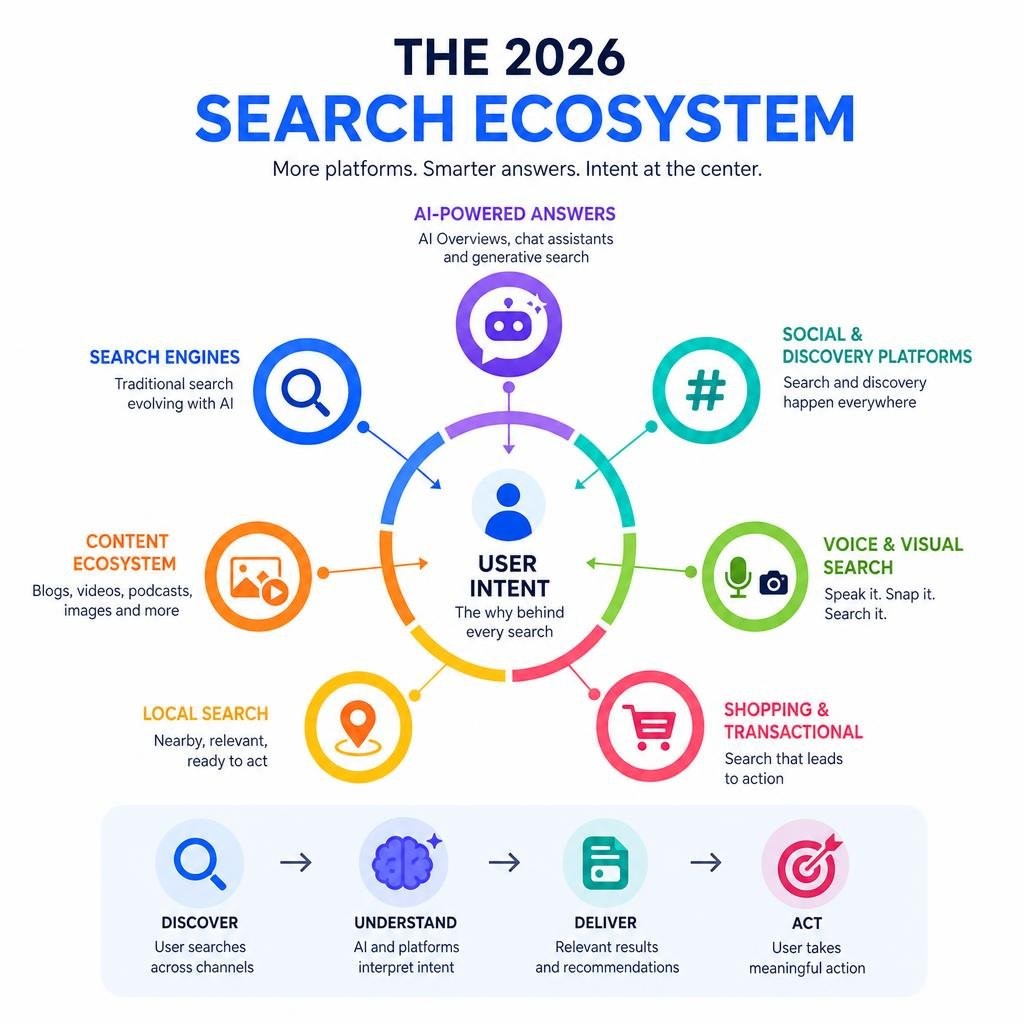
The search landscape in June 2026 is fundamentally different from just a few years ago. We are now operating in a “dual-surface era” where businesses need to optimize not only for traditional Search Engine Results Pages (SERPs) but also for AI-driven answer engines and generative AI models. This new reality introduces concepts like Generative Engine Optimization (GEO) and Answer Engine Optimization (AEO), which focus on ensuring your content is discoverable and cited by AI systems.

Optimizing for Google AI Overviews and LLM Citations
Google’s AI Overviews (AIOs) have rapidly become a prominent feature, appearing in over 50% of US searches. These AI-generated summaries often provide direct answers to user queries, synthesizing information from multiple sources without requiring a click to a specific website. This has led to a significant shift in user behavior, with 65% of Google searches now ending without a click to any website. Furthermore, the presence of AI Overviews can lead to a 61% drop in organic click-through rates for traditional listings.
To thrive in this environment, optimizing for LLM (Large Language Model) citations and AI Overviews is crucial. This means a strategic pivot from solely chasing clicks to also aiming for citation within these AI responses. Key strategies include:
- Semantic Completeness: Content must provide thorough, self-contained answers that don’t require users to seek information elsewhere. This has the highest correlation (r=0.87) with AI Overview selection.
- Answer-First Formatting: Start each section, particularly under H2 headings, with a concise (40-60 word) direct answer to a potential question, often including a key statistic.
- Structured Data: Implementing FAQPage, HowTo, Article, and Organization schema markup significantly increases the likelihood of AI Overview selection, with a 73% increase for pages with structured data.
- Topical Authority: Building comprehensive topic clusters with 5+ interconnected pages per topic is vital. Clustered content earns 3.2 times more AI citations than standalone pages, and 86% of AI citations come from sites with such clusters.
- E-E-A-T Signals: Emphasize Expertise, Experience, Authoritativeness, and Trustworthiness. Clearly showcase author credentials, cite reputable sources, and provide factual density.
- Freshness: Regularly update content. Pages not updated quarterly lose AI citations at 3x the normal rate.
While traditional SEO still matters, the focus has expanded. Brands cited within AI Overviews see a +35% increase in clicks, indicating that being a trusted source for AI is a new, powerful form of visibility. Staying current with the cutting-edge tools and strategies for this new era is paramount, and exploring Best AI Tools for SEO 2025 can provide a competitive edge.
Voice, Visual, and Agentic Search Frontiers
Beyond AI Overviews, the search landscape continues to diversify with the growth of voice, visual, and agentic search.
- Voice Search: With the proliferation of smart speakers and virtual assistants, voice search is increasingly common. Optimization requires targeting conversational keywords and long-tail queries, as 70% of voice queries are now phrased in natural language. Content should be structured to provide concise, direct answers (ideally 29-41 words) to common questions.
- Visual Search: Platforms like Google Lens allow users to search using images. For businesses, this means optimizing images with descriptive alt text, high-quality visuals, and relevant captions. Product images, in particular, should be clear and well-tagged to appear in visual shopping searches.
- Agentic Search: This emerging frontier involves AI agents performing complex tasks or research on behalf of users. Optimizing for agentic search means providing highly structured data about products, services, and processes, enabling AI agents to understand and utilize your information effectively. This often involves detailed schema markup for product specifications, pricing, availability, and service offerings.
These evolving search modalities underscore the need for a holistic SEO strategy that anticipates how users will interact with information in the future.
Executing and Measuring a Modern Search Campaign
An effective SEO strategy isn’t just about implementing best practices; it’s about continuous execution, rigorous measurement, and strategic adaptation. A well-defined SEO strategy should align with your overall business objectives, whether that’s increasing brand awareness, driving leads, or boosting e-commerce sales.
Building a Unified Digital Marketing and SEO Strategy
In today’s complex digital ecosystem, SEO rarely operates in isolation. It’s most powerful when integrated with other digital marketing channels. For example, combining SEO with PPC (Paid Per Click) campaigns can create a synergistic effect. Google’s own research indicates that dropping PPC efforts to focus solely on SEO can lead to an 89% drop in clicks. Conversely, adding PPC to existing organic rankings can increase overall clicks by 50%.
This integration allows for:
- Enhanced Brand Awareness: Both organic and paid visibility reinforce your brand’s presence across the SERPs.
- Leveraged Keyword Data: PPC campaigns can quickly test keywords for conversion potential, providing valuable data to inform your long-term organic keyword strategy. Similarly, high-performing organic keywords can be targeted in paid campaigns for even greater market saturation.
- Strategic Content Creation: Insights from both paid and organic search can guide the creation of content that resonates with user intent and performs well across channels.
For businesses seeking to maximize their online lead generation and sales, a unified approach is key. This often involves working with agencies that offer performance-focused SEO retainers that can manage and optimize multiple digital marketing facets concurrently, ensuring all efforts contribute to a cohesive and impactful strategy.
Tracking the Metrics That Matter to B2B Buyers
Measuring the success of your SEO efforts is critical for demonstrating ROI and guiding future strategy. For B2B buyers, the metrics often extend beyond simple traffic numbers to focus on tangible business outcomes. Key performance indicators (KPIs) include:
- Organic Sessions & Users: Track the quantity of visitors coming from organic search using tools like Google Analytics 4 (GA4). GA4 offers advanced event-based tracking, allowing for more granular insights into user behavior.
- Keyword Rankings & Visibility: Monitor your position for target keywords using Google Search Console and other SEO tools. This helps you understand your search visibility.
- Conversions & Lead Generation: The ultimate measure of success. Track form submissions, demo requests, phone calls, and other lead-generating actions that originate from organic search.
- Conversion Rate: The percentage of organic visitors who complete a desired action. This indicates the quality of your organic traffic and the effectiveness of your website in converting leads.
- Attribution Modeling: Understand which touchpoints (including organic search) contribute to a conversion. GA4 offers various attribution models to provide a clearer picture of your marketing channels’ impact.
- AI Citation Frequency: In the age of AI Overviews, tracking how often your content is cited by AI answer engines is a new, crucial metric. This indicates your content’s authority and extractability by LLMs.
- Return on Investment (ROI): Calculate the revenue generated from organic search compared to the investment in SEO, providing a clear financial justification for your efforts.
Regularly analyzing these metrics allows us to identify what’s working, pinpoint areas for improvement, and adapt the SEO strategy to achieve optimal results. Understanding How to Not Get Ripped Off by a Monthly SEO Retainer also involves clear reporting on these metrics, ensuring transparency and accountability.
Frequently Asked Questions About Search Optimization
What is the difference between SEO and SEM, and when should I use each?
SEO (Search Engine Optimization) focuses on improving your website’s visibility in organic, unpaid search results. It involves optimizing content, technical aspects, and earning backlinks to rank higher naturally over time. SEM (Search Engine Marketing) is a broader term that includes both SEO and paid search advertising (like PPC). So, while SEO is a component of SEM, SEM also encompasses strategies that involve paying for ad placement on search engine results pages.
You should use SEO for long-term, sustainable growth, building brand authority and trust, and acquiring customers at a lower cost over time. It’s an ongoing investment that yields compounding returns. You should use paid SEM (PPC) for immediate visibility, targeted campaigns, testing keywords, and driving quick traffic or sales. For instance, if you’re launching a new product or running a seasonal promotion, PPC can deliver instant results. In 2025, worldwide search advertising spending is projected to reach $351.55 billion, demonstrating its continued importance for immediate impact. Ideally, the most effective digital marketing strategies integrate both SEO and paid SEM, leveraging the strengths of each to create a comprehensive and robust online presence.
How long does it take to see measurable results from SEO?
SEO is a marathon, not a sprint. While some minor technical fixes or on-page optimizations might show initial shifts within weeks, significant and measurable results typically take longer. Most businesses start seeing SEO traction in 3-6 months, with stronger momentum building over 6-12 months.
The timeline depends on several factors:
- Competition: Highly competitive industries will naturally take longer to see substantial gains.
- Website’s Current State: A brand-new website or one with significant technical issues will require more foundational work before seeing results.
- Investment & Consistency: Consistent effort, high-quality content creation, and ongoing optimization are crucial.
- Algorithm Updates: Search engine algorithms are constantly evolving, requiring continuous adaptation.
The “Ecosystem” layer of authority building, which involves compounding returns and increased ranking stability, often begins to activate at 24-36 months and matures fully at 36-60 months. This long-term perspective is essential for understanding the true power of SEO.
How do AI Overviews affect organic click-through rates?
AI Overviews have significantly impacted organic click-through rates (CTRs) by providing direct answers within the search results page, leading to “zero-click searches.” With 65% of Google searches now ending without a click to any website, and 50%+ of Google searches triggering AI Overviews, the traditional organic listings often see a reduced CTR. In fact, a 61% drop in organic CTR has been observed for queries where AI Overviews appear.
However, this doesn’t mean organic search is dead. Instead, it highlights a shift in how value is delivered and consumed. For businesses, the new goal is not just to rank organically but also to be cited within these AI Overviews. Brands that are cited inside AI Overviews actually receive +35% more clicks, as users may still click through to the source for more detailed information or to verify the data. This means content needs to be optimized for “extractability” by AI models through semantic completeness, answer-first formatting, and structured data, ensuring your brand becomes a trusted source for AI-generated answers.
Conclusion
In the dynamic digital landscape of June 2026, driving business growth demands a sophisticated and adaptable approach to online visibility. We’ve explored how digital marketing and SEO, though distinct, are inextricably linked, with organic search serving as a powerful, cost-effective engine for sustainable growth. Understanding the mechanics of crawling, indexing, and ranking provides the foundational knowledge for any successful strategy.
The four pillars of SEO—on-page, off-page, technical, and local—must work in concert to build a robust and authoritative online presence. Critically, the emergence of AI search, including Google AI Overviews, has ushered in a “dual-surface era,” requiring a strategic pivot towards optimizing for both traditional SERPs and AI citations. This means prioritizing semantic completeness, answer-first content, and structured data, alongside traditional best practices.
Success in this new era hinges on a unified digital marketing and SEO strategy, meticulously tracked through relevant metrics that demonstrate tangible ROI. By embracing these advanced SEO and AI search optimization techniques, businesses can future-proof their digital presence, ensure they remain discoverable, and achieve sustainable growth in an ever-evolving online world.