Modernizing Organizations: Cybersecurity and Interactive Digital Displays
The Strategic Impact of Modern Technology Solutions
Modern technology solutions are not just about fixing problems; they are about strategically positioning an organization for future growth, efficiency, and resilience. This involves a careful balance of leveraging scalable cloud platforms, adopting advanced AI capabilities, and maintaining robust local support where it matters most. Understanding the nuances of these different approaches is key to making informed technology investments.
Managed IT Benefits for Small and Medium Businesses
For small and medium-sized businesses (SMBs), navigating the complex world of IT can be daunting. This is where managed IT services become invaluable, offering a strategic alternative to traditional break-fix models.
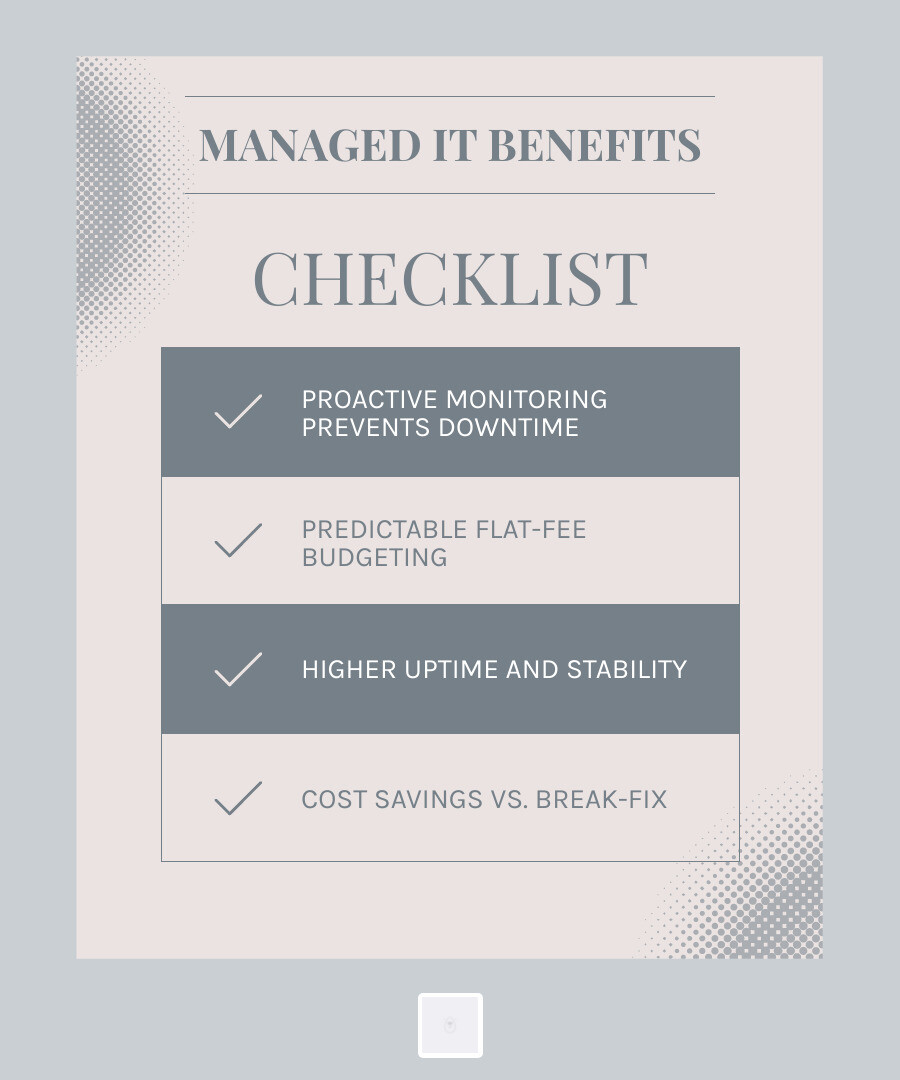
Proactive vs. Reactive Support: One of the primary advantages of managed IT is its shift from reactive problem-solving to proactive prevention. Instead of waiting for a system to fail and then calling for help, managed service providers (MSPs) continuously monitor networks, systems, and devices. This allows them to identify and address potential issues before they escalate into costly downtime. For instance, they might detect unusual network traffic indicating a potential cyber threat or notice a server nearing capacity and recommend an upgrade before performance is impacted. This proactive approach ensures greater uptime and operational stability, allowing businesses to focus on their core activities without constant IT worries.
Predictable Budgeting: Financial predictability is a major draw for SMBs. Many MSPs offer flat-fee support models, consolidating all IT costs—from maintenance and monitoring to helpdesk support and cybersecurity—into a single, predictable monthly payment. This eliminates the financial surprises often associated with hourly break-fix services, where costs can skyrocket during an unexpected outage or security incident. By knowing their IT expenses in advance, businesses can budget more effectively and allocate resources strategically.
Testimonials and Reliability: The value of reliable IT support and proactive monitoring is consistently echoed in customer testimonials. Businesses frequently highlight how consistent, high-quality IT support prevents the kind of downtime that can cost thousands of dollars in lost productivity and revenue. For example, an office manager praised a technology solution provider for seamlessly routing programs across eight locations, while a regional manager lauded after-hours hardware rollouts that prevented operational disruptions. These real-world examples underscore the importance of a partner who understands that technology should be an enabler, not a source of stress. The peace of mind that comes from knowing your systems are being diligently watched and maintained is an immeasurable benefit.
The Role of AI in Modern Enterprise Platforms
Artificial intelligence is no longer a futuristic concept; it’s an integral component of modern enterprise technology solutions, reshaping how organizations manage data, automate processes, and derive insights. Companies like Workday, Databricks, Snowflake, and Google Cloud are at the forefront of this revolution.
Unified Data Clouds: The sheer volume of data generated by businesses today demands sophisticated solutions. Snowflake’s AI Data Cloud, for example, enables organizations to unify vast datasets across disparate environments, making it easier to analyze and derive actionable intelligence. This unification can lead to significant cost efficiencies; VodafoneZiggo, for instance, reported a 50% reduction in data infrastructure costs and improved data timeliness to over 96% by leveraging Snowflake. Similarly, Indeed achieved 43-74% cost savings by querying Apache Iceberg tables with Snowflake, showcasing the platform’s ability to optimize data management and reduce expenses.
AI-Driven Operations: AI is transforming core business functions. Workday Illuminate uses next-generation AI to streamline and automate HR and finance processes, delivering measurable business value through enhanced efficiency and accuracy. Databricks’ Agent Bricks, on the other hand, empowers the creation of AI agents that continuously refine their quality and accuracy using custom data, leading to more intelligent automation and decision-making. These platforms move beyond simple automation, leveraging AI to provide natural language insights and predictive analytics that drive strategic outcomes. Research from Workday highlights that 73% of business leaders feel pressure to adopt AI, underscoring its perceived importance for organizational agility and competitive advantage.
Retail and Healthcare Impact: The influence of AI extends across diverse industries. In the retail sector, 9 out of the top 10 companies trust Google Cloud for their AI innovation, utilizing its capabilities for everything from personalized customer experiences to optimizing supply chains. Snap, for example, boosted US engagement by 2.5x using Gemini’s multimodal capability on Google Cloud. In healthcare, the criticality of AI is equally pronounced, with 85% of healthcare leaders viewing interoperability as foundational to effectively scaling AI. This emphasizes the need for seamless data exchange between systems to unlock AI’s full potential in improving patient care and operational efficiency.
Why Local Support and Hardware Maintenance Still Matter
While cloud services and remote support have gained immense popularity, the importance of local IT support and hands-on hardware maintenance cannot be overstated. There are specific scenarios where a physical presence is not just convenient but absolutely essential.
The Importance of Local Presence: Remote monitoring and cloud-based solutions are powerful, but they have limitations. When a physical network component fails, a server needs to be replaced, or complex cabling issues arise, a local technician is indispensable. On-site support ensures rapid response times for critical hardware failures, minimizing downtime that remote teams simply cannot address. For businesses in specific regions, like Central Texas, having a local provider means faster, more reliable service for these physical infrastructure needs.
Specialized Repair Services: Beyond general hardware, many technology solutions providers offer highly specialized repair services that extend the life of expensive equipment. Microsoldering, for instance, is a delicate technique used for repairing intricate components like iPad charging ports or motherboard issues in mobile devices. These precise repairs require specialized tools and expertise that can only be performed in a dedicated repair facility. Offering such services, alongside general mobile device and computer repair, provides a cost-effective alternative to full device replacement, conserving capital for organizations.
Personalized Service: Local providers often strike a unique balance between the scale needed to handle complex IT challenges and the personalization required for tailored service. They can develop long-term IT strategies that are deeply aligned with the specific geographic, operational, and cultural needs of local businesses. For example, a local IT partner can provide nuanced advice on network configurations that account for regional internet infrastructure limitations or offer on-site training that is more effective than remote alternatives. This personalized approach fosters stronger relationships and ensures that technology solutions are not just implemented but truly integrated into the business’s unique ecosystem.
Specialized Industry Applications and Risk Mitigation

The application of technology solutions often extends beyond general IT support, delving into highly specialized areas tailored to specific industries. These solutions are designed not only to enhance operational efficiency but also to mitigate significant risks, particularly in areas like security and compliance.
Enhancing Operational Efficiency with Managed Technology Solutions
Modernizing operations means more than just updating software; it involves integrating various technological components to create a seamless, efficient, and secure environment.
Interactive Digital Displays: In today’s dynamic work environments, effective communication is paramount. Interactive digital displays and advanced audio-visual systems play a crucial role, especially in sectors like education, hospitality, and B2B. They facilitate engaging presentations, provide real-time information, and can even serve as interactive kiosks, improving internal communication and enhancing client engagement. For an educational institution, these displays can transform learning spaces, while in a corporate setting, they can streamline meeting processes and improve collaborative efforts. For those seeking advanced Educational technology solutions, these interactive tools are becoming indispensable.
Cloud-Based ERP Systems: The transition to cloud-based Enterprise Resource Planning (ERP) systems marks a significant leap from antiquated, on-premise setups. Cloud technology enables staff to work securely from virtually any location, fostering flexibility and remote collaboration. By utilizing decentralized data storage, these systems improve data accessibility, reduce the burden of maintaining physical infrastructure, and offer enhanced scalability. This shift not only streamlines operations but also provides a robust foundation for future digital transformation initiatives, ensuring business continuity and agility.
Long-Term IT Strategies: Effective modernization requires a departure from short-term fixes in favor of comprehensive, long-term IT strategies. Technology solution providers often conduct thorough facility reviews to understand an organization’s unique needs and future goals. They then design and implement systems that are not only reliable and easy to use but also come with comprehensive staff training. This ensures that new technologies are adopted effectively, maximizing their utility and providing a high return on investment. Focusing on root-cause problem-solving, rather than just patching symptoms, leads to smoother long-term network performance and greater operational stability.
Industry-Specific Technology Solutions for Security and Compliance
Different industries face unique security and compliance challenges, necessitating specialized technology solutions that address their particular needs.
Healthcare and Safety: In healthcare settings, patient safety and data privacy are paramount. Specialized healthcare systems, including patient monitoring, nurse call systems, and integrated communication platforms, are critical for enhancing patient safety and improving response times in hospitals and care homes. Interoperability is a key factor here, allowing different systems to seamlessly share data, which is essential for coordinated care and better clinical outcomes. Compliance with regulations like HIPAA also drives the need for robust, secure, and integrated technology solutions.
Physical Security: Industries ranging from self-storage facilities to retail, commercial businesses, and government agencies rely heavily on physical security measures. Modern security camera systems provide comprehensive surveillance, while advanced access control systems ensure that only authorized personnel can enter restricted areas. For government applications, solutions often need to be NDAA compliant, meaning they adhere to strict national defense authorization act standards for security and supply chain integrity. These systems not only deter crime but also provide crucial evidence in the event of an incident, contributing significantly to risk management.
Access Management: Beyond basic entry control, sophisticated access management systems are vital for maintaining security and accountability. These systems ensure that only personnel with the appropriate credentials can access specific locations during designated times. They provide a digital audit trail, logging every entry and exit, which is essential for compliance, internal investigations, and insurance purposes. This level of granular control is critical in environments handling sensitive information or valuable assets, enabling organizations to manage risk effectively and maintain a secure operational footprint.
Lowering Organizational Risk Through Proactive Cybersecurity
In an increasingly interconnected world, cybersecurity is not merely an IT concern but a fundamental business imperative. Proactive measures are essential to protect against evolving threats and ensure business continuity.
Lowering the Risk of Ransomware: Ransomware attacks can be devastating, leading to significant financial losses and reputational damage. While no system can offer absolute immunity, organizations can Prevent ransomware with technology solutions and substantially reduce their vulnerability through a combination of robust strategies. This includes implementing constant data backups, ensuring regular cyber threat protection updates, and maintaining a diligent IT patching regimen. Regular patching closes known vulnerabilities that attackers often exploit, while comprehensive backups allow for rapid recovery in the event of a successful attack.
Layered Security Stacks: A truly effective cybersecurity posture goes far beyond basic antivirus software. It involves a multi-layered security stack designed to protect against various types of threats. This typically includes Security Information and Event Management (SIEM) systems for real-time threat detection, Security Operations Center (SOC) services for 24/7 monitoring and incident response, multi-factor authentication (MFA) to prevent unauthorized access, and robust firewalls. This layered approach creates multiple barriers for attackers, significantly increasing the difficulty of a breach.
AI Governance: As AI becomes more deeply embedded in business operations, the need for responsible AI governance becomes critical. This involves establishing clear guidelines and ethical frameworks for the development and deployment of AI systems. Adhering to standards like ISO 42001 for trustworthy innovation ensures that AI agents and models are deployed responsibly, securely, and ethically within the corporate ecosystem. This not only mitigates risks associated with AI bias or misuse but also builds trust in AI-driven decision-making processes.
FAQ: Common Questions About Technology Solutions
Q: What is the difference between Managed IT and Break-Fix services? A: Managed IT is a proactive, subscription-based model where a provider continuously monitors, maintains, and manages your IT systems to prevent issues before they arise. In contrast, break-fix is a reactive model where you only pay for IT support when something has already gone wrong and needs repair. Managed IT aims to prevent downtime, while break-fix addresses it after the fact.
Q: Why is local IT support still necessary if we use cloud services? A: While cloud services handle much of your digital infrastructure remotely, local IT support remains crucial for physical hardware maintenance, on-site network troubleshooting, and specialized repairs like microsoldering that cannot be performed remotely. A local presence ensures rapid response for physical failures and hands-on assistance when needed.
Q: How does AI improve business technology solutions? A: AI significantly enhances business technology solutions by improving data analytics, automating repetitive tasks in areas like HR and finance, and providing natural language interfaces for complex data querying. This leads to faster, more informed decision-making, increased efficiency, and the ability to derive deeper insights from vast datasets.
Q: What industries benefit most from specialized access control? A: Industries that require strict security, compliance, and asset protection benefit immensely from specialized access control. This includes healthcare (to protect patient data and restricted areas), education (for campus safety and secure facilities), government (for classified areas and data centers), and self-storage facilities (for unit security and customer access management).
Author Bio: This article was prepared by the technology strategy team at tekRESCUE. With decades of experience in managed IT, cybersecurity, and digital infrastructure, tekRESCUE helps organizations navigate the complexities of modern technology to achieve sustainable growth and security.
Contact Information:
- Company Name: tekRESCUE
- Phone: (512) 843-2835
- Website: Prevent ransomware with technology solutions
- Primary Service Locations: San Marcos TX, Central Texas, DFW (Dallas-Fort Worth).