Maximizing Online Visibility with Advanced SEO Strategies
Technical SEO Foundations for High-Performing Sites
The digital landscape is constantly reshaping, and by August 2026, search engine optimization (SEO) has evolved dramatically. The rise of AI-driven search, with features like AI Overviews directly answering queries, means that simply ranking number one is no longer the sole measure of success. In this new era, businesses face the challenge of not just appearing in search results, but also ensuring their content is cited by intelligent systems and delivers tangible value.
We understand that traditional SEO strategies, while foundational, now require significant adaptation. User behavior is shifting, with a growing number of searches resulting in zero clicks as AI provides instant answers. This calls for a more sophisticated approach to digital visibility, focusing on authority, relevance, and technical excellence across all search surfaces. To truly thrive in this environment, businesses need a modern, performance-based SEO model that aligns directly with their growth objectives.
In this comprehensive guide, we will explore the most effective SEO strategies for 2026. We will dive into critical technical foundations, discuss how to build powerful topical authority, and introduce the concept of Generative Engine Optimization (GEO) for AI-driven search. We will also cover sustainable link building, integrated paid media tactics, and modern ways to measure SEO success. Our goal is to equip you with the knowledge to navigate this dynamic search environment, ensuring your online presence is not just visible, but truly impactful.
In the ever-evolving landscape of search, technical SEO remains the bedrock upon which all other optimization efforts are built. Think of it as the plumbing of your website: when it works seamlessly, no one notices, but when it fails, everything else grinds to a halt. In 2026, a robust technical foundation is more critical than ever, ensuring that search engines can efficiently crawl, index, and understand your content, while simultaneously delivering a superior user experience. Without these fundamental elements in place, even the most compelling content or innovative strategies can fall flat, failing to achieve desired visibility.
Our approach to SEO emphasizes that these technical foundations are non-negotiable. They directly influence how well your site performs across various metrics, from page speed to overall site architecture, and play a crucial role in how search engines perceive your site’s reliability and authority. This means regular audits and proactive maintenance are essential to stay ahead in a competitive digital environment.
Core Web Vitals and Technical Infrastructure
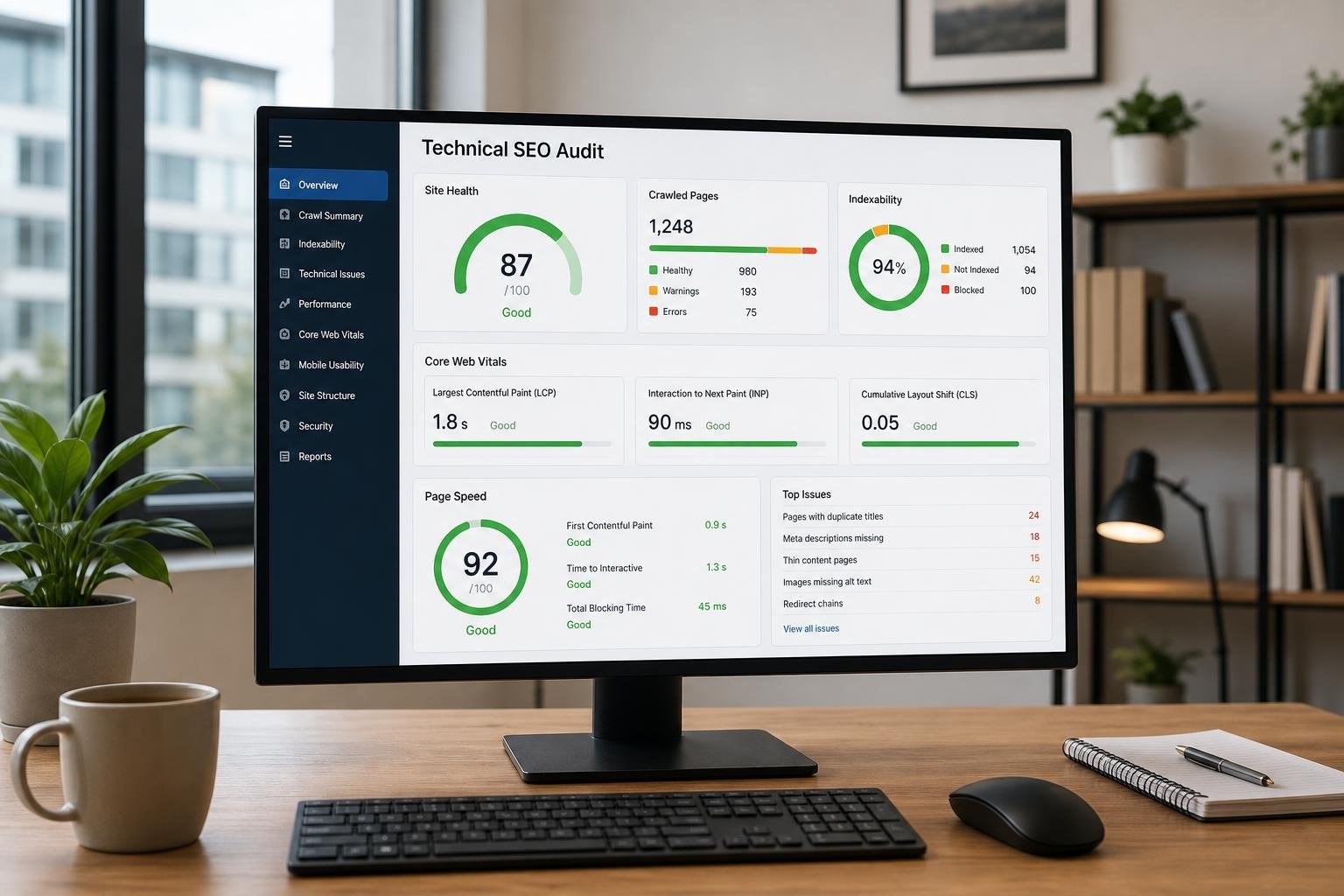
Core Web Vitals (CWV) are a set of metrics that Google uses to measure user experience on the web. These metrics — Largest Contentful Paint (LCP), Interaction to Next Paint (INP), and Cumulative Layout Shift (CLS) — assess loading performance, interactivity, and visual stability, respectively. In 2026, maintaining excellent CWV scores is paramount. Pages meeting all three thresholds see 24% fewer users abandoning page loads, directly impacting engagement and conversions.
LCP measures how quickly the main content of a page loads, ideally under 2.5 seconds. INP, which officially replaced First Input Delay (FID) in 2024, measures the responsiveness of a page to user interactions, aiming for under 200 milliseconds. CLS quantifies unexpected layout shifts, striving for a score below 0.1. Optimizing these elements involves compressing and lazy-loading images, deferring non-critical JavaScript, and eliminating layout-shifting banners or pop-ups. Mobile optimization is also integral, as Google employs mobile-first indexing, meaning the mobile version of your site is the primary one used for ranking. A truly effective, performance-based SEO model will deeply integrate CWV optimization into its core strategy, recognizing that speed and responsiveness are not just ranking factors but essential components of a positive user journey.
Schema Markup and Crawlability Optimization
Beyond speed, search engines need to understand the context and meaning of your content. This is where schema markup, or structured data, comes into play. By implementing schema in JSON-LD format, we provide explicit clues about your content to search engines and large language models (LLMs). This can include marking up articles, organizations, FAQs, products, or local businesses. For example, applying Article, Organization, and FAQPage schema can significantly help AI Overviews and LLMs parse and cite your content accurately. While only about 31% of websites currently implement structured data, it’s a powerful tool for enhancing visibility, especially in an AI-driven search landscape. Implementing schema.org markup specifically for published and modified dates can also directly improve crawl and recrawl rates, ensuring your content is always fresh in the eyes of search engines.
Crawlability and indexation are equally fundamental. Google processes an estimated 8.5 billion searches per day, and for your content to appear in these results, search engine bots must be able to discover and read your pages. This involves ensuring a clean site architecture, managing your robots.txt file, submitting up-to-date sitemaps, and correctly using canonical tags to prevent duplicate content issues. Regular site audits using tools like Google Search Console are essential to identify and rectify any crawl errors or indexation blocks that might be hindering your site’s visibility.
Modern Content Execution and Topical Authority

In 2026, content is no longer just about keywords; it’s about establishing comprehensive topical authority. With 95% of web pages receiving zero organic traffic, simply publishing content isn’t enough. We must strategically create content that demonstrates deep expertise and covers a subject exhaustively, signaling to search engines that our site is a go-to resource. This approach moves beyond individual keyword rankings to building a site-wide reputation as an authoritative source, which is increasingly important for both traditional search and AI-driven answer engines.
The shift towards topical authority acknowledges that Google no longer evaluates individual pages in isolation but rather in the context of all content published on a domain around a specific topic. This holistic view helps search engines understand the breadth and depth of your knowledge, rewarding sites that provide thorough, interconnected information.
Building Content Clusters and Pillar Pages
A cornerstone of modern content strategy is the content cluster model. This involves selecting a broad, high-level topic (the “pillar page”) and then creating several detailed subtopic articles (the “cluster content”) that link back to the pillar page. For instance, a pillar page on “Digital Marketing Strategies” might be supported by cluster articles on “SEO Best Practices,” “Paid Social Media Advertising,” and “Email Marketing Automation.”
Pillar pages typically range from 2,500 to 5,000 words, offering a comprehensive overview of the core topic, while cluster articles are generally 800 to 2,000 words, diving deep into specific aspects. The power of this model lies in its internal linking structure, where all cluster content links to the pillar, and the pillar links back to relevant clusters. This semantic coverage helps search engines understand the relationships between your content pieces, reinforcing your site’s authority on the overarching topic. For example, one B2B SaaS project saw its pillar page jump from position 18 to 4 in just 11 weeks by implementing a 6-article content cluster with solid internal linking, without acquiring any new backlinks. This demonstrates the immense power of a well-executed content cluster strategy.
The Role of E-E-A-T in Effective SEO Strategies
E-E-A-T, which stands for Experience, Expertise, Authoritativeness, and Trustworthiness, is Google’s quality framework that guides human quality raters and influences algorithmic evaluations. While Google explicitly states E-E-A-T is not a direct ranking factor, it is a foundational principle that underpins how content quality is assessed. In an era flooded with AI-generated content, demonstrating genuine human E-E-A-T is crucial for differentiation and building user trust.
- Experience: Show that the content creator has first-hand experience with the topic. This could be through personal anecdotes, case studies, or practical examples.
- Expertise: Ensure content is created by individuals with verifiable knowledge or credentials in the subject matter. For “Your Money Your Life” (YMYL) topics like finance or health, this means explicitly attributing content to credentialed authors.
- Authoritativeness: Establish your website or author as a recognized authority in your niche. This is built over time through consistent, high-quality content and external validation (e.g., mentions, links).
- Trustworthiness: Provide accurate, unbiased information, cite primary sources, maintain transparent policies, and keep content updated.
To effectively leverage E-E-A-T, we must focus on creating original, insightful content that goes beyond surface-level information. This means incorporating proprietary data, original research, and unique perspectives that only genuine human experience can provide. Regularly auditing and updating content also signals trustworthiness and relevance to both users and search engines.
Generative Engine Optimization and AI Search Adaptation
The advent of AI-driven search, characterized by AI Overviews and sophisticated large language models (LLMs) like ChatGPT and Perplexity, has introduced an entirely new dimension to SEO: Generative Engine Optimization (GEO). This shift is profound, as AI Overviews now appear on roughly 15% of all queries, and 30-40% of informational queries are answered by AI systems without a click. Our traditional focus on driving clicks to our websites must now expand to optimizing for citations and direct answers within these generative interfaces.
GEO vs Traditional SEO Strategies
Traditional SEO primarily aims to rank pages high in organic search results, driving clicks to a website. GEO, on the other hand, focuses on structuring content so that AI systems can easily extract, synthesize, and cite it as a source in their generated answers. This means that while traditional SEO still seeks blue-link rankings, GEO is about being the authoritative source that AI chooses to quote.
Here’s a comparison:
Feature Traditional SEO (2026) Generative Engine Optimization (GEO) (2026) Primary Goal Drive clicks to website, improve organic rankings Be cited as a source by AI, provide direct answers Key MetricsOrganic traffic, CTR, keyword rankings Citation frequency, passage density, share of voice in AI Overviews Content FocusComprehensive articles, keyword optimization Explicit answer blocks, structured summaries, entity consistency Optimization Tactics On-page SEO, technical SEO, link building Schema markup, direct answer formatting, prompt intent matching Traffic Impact Direct website visits Increased brand visibility, indirect traffic, thought leadership Search Intent Match user queries for ranking Anticipate natural language prompts, provide quotable passages Authority Signal Backlinks, domain authority Passage density, entity consistency across web, primary-source style
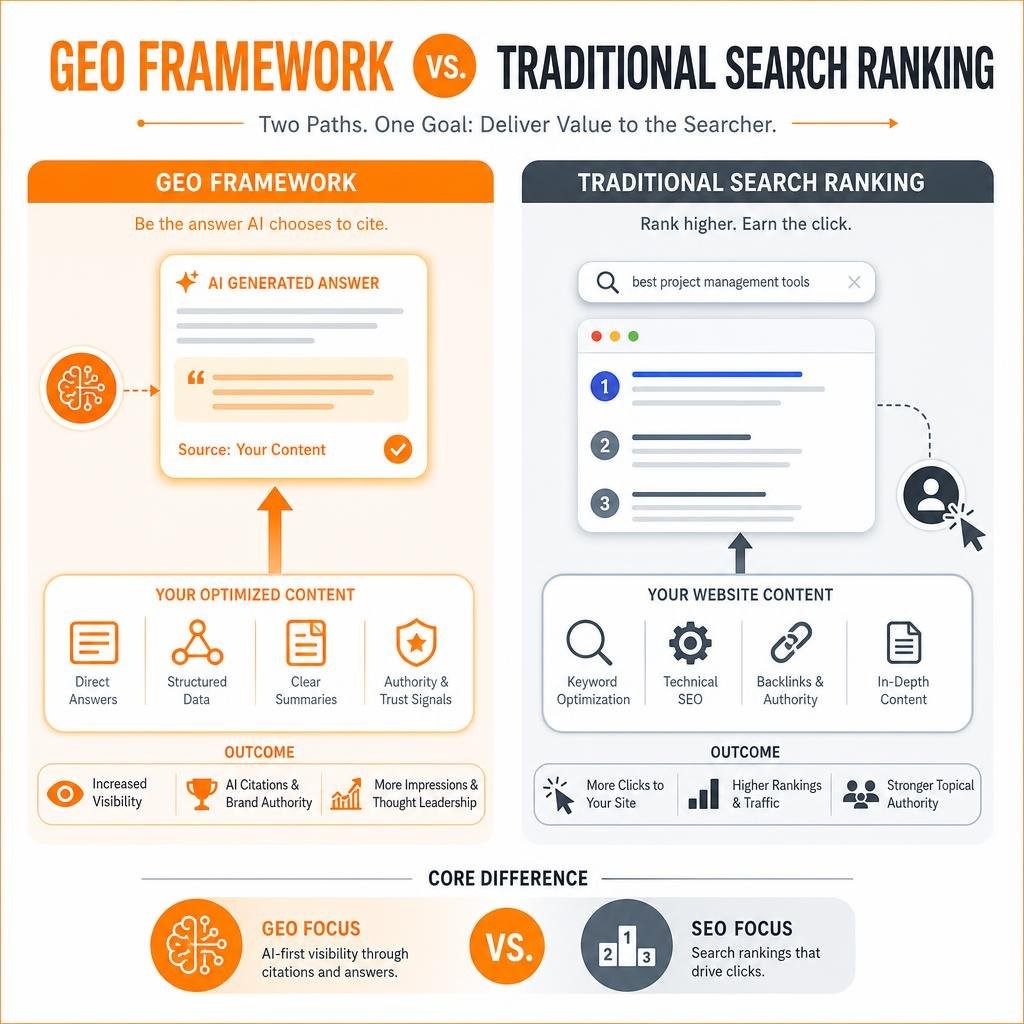
The rise of zero-click searches, where AI provides answers directly on the SERP, means that even if impressions increase, CTR can drop by an average of 34% for queries with an AI Overview. This necessitates a dual strategy: maintaining traditional SEO for direct traffic while simultaneously optimizing for AI citation.
Optimizing for AI Overviews and LLMs
To optimize for AI Overviews and LLMs, we need to design content with “extractability” in mind. This means creating content that is easy for AI to understand, process, and quote.
- Direct Answers and Structured Summaries: Place concise, direct answers (ideally 100-180 words) at the beginning of relevant sections. These “encyclopedic answer blocks” are highly favored by LLMs for lifting verbatim.
- Schema Markup: As discussed, implementing structured data like Article, FAQ, and How-To schema helps AI engines parse your content and identify key information points.
- Entity Consistency: Ensure that key entities (people, organizations, concepts) are consistently named and described across your site and linked to relevant knowledge graphs. LLMs prioritize sources with strong entity consistency.
- Prompt Intent Matching: Conduct “prompt research” in addition to traditional keyword research. This involves understanding the natural language questions users ask AI tools and structuring your content to directly address those specific intents (informational, comparative, evaluative, procedural). For example, using side-by-side tables for comparative queries or clear FAQ blocks for informational ones.
- Quality and Authority: LLMs prioritize source selection based on passage density, entity consistency, and a primary-source style over traditional keyword density. They also favor earned media and authoritative third-party sources over brand-owned content, emphasizing the need for genuine credibility.
By adopting these GEO strategies, we can increase the likelihood of our content being cited by AI Overviews, ChatGPT, and Perplexity, ensuring our brand remains visible and authoritative even as search behavior evolves.
Sustainable Link Building and Paid Media Integration
In 2026, an effective SEO strategy extends beyond on-page and technical optimizations to encompass robust off-page strategies and a synergistic integration with paid media. While the nature of link building has evolved, its importance as a core ranking signal remains undeniable. Simultaneously, smart integration of organic and paid search channels can create a powerful, compounding advantage, maximizing overall digital visibility and business impact.
Quality Link Building Tactics in 2026
Link building in 2026 is less about volume and more about the quality, relevance, and editorial integrity of incoming links. Google’s algorithms are increasingly sophisticated at discerning natural, valuable links from manipulative tactics. Therefore, we must focus on strategies that genuinely earn high-authority backlinks.
Here are high-impact link-building tactics:
- Digital PR: Create compelling, newsworthy content (e.g., original research, industry reports, unique data visualizations) that attracts media attention and earns editorial links from reputable publications. Publishing proprietary data and research is an excellent way to naturally earn high-authority editorial links.
- Original Research and Data: Invest in conducting and publishing unique studies or surveys. When other sites cite your data, they naturally link back to your original source, providing powerful, relevant backlinks.
- Expert Contributions: Offer expert commentary, guest posts (only on highly relevant and authoritative sites), or interviews to industry-leading publications. This not only builds links but also reinforces E-E-A-T.
- Broken Link Building: Identify broken links on authoritative websites in your niche and suggest your relevant content as a replacement.
- Resource Page Link Building: Find pages that curate resources on a topic relevant to your business and propose your content for inclusion.
Tactics to avoid include automated link-buying networks, low-quality directory links, and templated guest posting schemes, as these can lead to penalties. Instead, focus on building genuine relationships and creating content that naturally attracts links. For businesses seeking to navigate these complexities and ensure their link-building efforts are both ethical and effective, exploring customized SEO services can provide tailored strategies and expert execution.
Combining Organic and Paid Search Channels
Integrating SEO and paid media strategies creates a powerful synergy that amplifies overall marketing efforts. Instead of viewing them as separate silos, we can leverage the strengths of each to achieve a compounding advantage.
- Keyword Testing: Paid search campaigns can quickly test keyword performance, providing immediate data on conversion rates, cost-per-click, and user intent. This valuable insight can then inform our organic keyword strategy, allowing us to prioritize high-converting terms for content creation and optimization, accelerating keyword conversion discovery by 12-18 months compared to organic testing alone.
- Visibility Amplification: For highly competitive keywords where organic ranking takes time, paid ads can provide immediate visibility, capturing traffic while organic efforts mature. Conversely, strong organic rankings can reduce the need for paid ads, freeing up budget for other initiatives.
- Audience Insights: Data from paid campaigns (e.g., ad copy performance, audience demographics) can inform organic content strategy, helping us create more relevant and engaging content.
- Conversion Alignment: By sharing conversion signals and goals between SEO and paid media teams, we can ensure both channels are optimized towards the same business objectives. This integrated approach has shown significant results, with some financial institutions achieving a 91% drop in ad costs and over $200 million in term deposits by aligning paid and organic search.
This holistic approach ensures that our marketing spend is optimized, and our brand maintains maximum visibility across all stages of the customer journey, whether through organic discovery or targeted advertising.
Measuring Success and Impact with Future-Proof SEO Strategies
In an era where AI-generated answers reduce click-through rates, the traditional metrics of SEO success require re-evaluation. Simply tracking keyword rankings or organic traffic volume no longer tells the full story. We need measurement frameworks that account for the nuances of AI Overviews, zero-click searches, and the broader impact of SEO on business outcomes. The focus must shift from vanity metrics to key performance indicators (KPIs) that directly reflect business value and demonstrate true ROI.
Modern Key Performance Indicators and Timelines
To accurately measure SEO success in 2026, we advocate for a more sophisticated set of KPIs:
- Assisted Conversions: Instead of solely crediting the last click, we should analyze assisted conversions in Google Analytics 4 (GA4) to understand how organic search contributes to the overall customer journey, even if it’s not the final touchpoint.
- Organic Conversion Rate: This measures the percentage of organic visitors who complete a desired action (e.g., purchase, lead form submission). It’s a direct indicator of the quality and relevance of organic traffic.
- Share of Voice (SoV): Beyond just ranking, SoV measures your brand’s visibility across all relevant search surfaces, including traditional organic results, AI Overviews, featured snippets, and even mentions in LLM conversations. This provides a more comprehensive view of your brand’s presence.
- Branded vs. Non-Branded Traffic Split: Monitoring this split helps understand brand awareness and the effectiveness of content in capturing new audiences versus serving existing demand.
- LLM Citation Share: Track how often your content is cited by major AI models. This is a critical GEO metric, indicating your success in becoming an authoritative source for generative answers.
How long does SEO typically take to show results? SEO is a long-term investment, not a quick fix. While technical fixes and schema implementation can yield improvements in weeks, most SEO investments take:
- 3-6 months: To produce measurable organic traffic gains, especially for initial keyword rankings and content refreshes.
- 6-12 months: For significant growth and to compound into meaningful revenue impact, as topical authority builds and higher-competition terms begin to rank.
- Beyond 12 months: For sustained market leadership and exceptional ROI, with an average ROI from SEO investment of 700% over three years.
Factors influencing this timeline include competition level, the current state of your website’s technical SEO, the quality and consistency of content creation, and the effectiveness of your link-building efforts. Consistent monitoring, adaptation, and a strategic mindset are crucial for navigating this timeline successfully.
Frequently Asked Questions About SEO Strategies
We often encounter common questions about the complexities and expectations of SEO in today’s dynamic environment. Here, we address some of the most pressing inquiries.
How long does it take to see results from an SEO strategy?
As highlighted earlier, SEO is a marathon, not a sprint. While some technical improvements or content refreshes might show early signals within a few weeks, most comprehensive SEO strategies require 3 to 6 months to produce measurable organic traffic gains. Significant growth and compounding returns, leading to meaningful revenue impact, typically take 9 to 12 months. The timeline is influenced by factors such as your industry’s competitiveness, the current health of your website, and the resources invested in content and authority building. Patience and consistent effort are key to realizing the full potential of your SEO investment.
What is the difference between GEO and traditional SEO?
The core difference lies in their primary objectives and how they interact with search engines. Traditional SEO focuses on optimizing your website to rank high in search engine results pages (SERPs), primarily to drive clicks to your site. It relies on algorithms that consider factors like keywords, backlinks, and technical health to determine ranking.
Generative Engine Optimization (GEO), on the other hand, is specifically designed for AI-driven search environments, such as Google AI Overviews and LLMs like ChatGPT and Perplexity. Its goal is not necessarily to secure a “blue link” ranking, but rather to ensure your content is cited, extracted, or synthesized by these AI systems to directly answer user queries. GEO focuses on content structure, direct answer formatting, entity consistency, and specific schema markup that makes your information easily digestible and quotable by AI. Traditional SEO aims for clicks, while GEO aims for citations and direct answers.
Why are technical foundations critical for modern rankings?
Technical foundations are critical because they dictate how efficiently search engines can crawl, index, and understand your website. Without a solid technical base, even the most valuable content can remain undiscovered or poorly understood by search algorithms. Key elements like Core Web Vitals directly impact user experience; slow loading times or unstable layouts can lead to high bounce rates, signaling to search engines that your site isn’t user-friendly.
Furthermore, proper site architecture, clean URLs, and effective use of schema markup ensure that search engines can accurately interpret your content’s context and relevance. In the age of AI, structured data becomes even more vital, as it provides explicit signals to LLMs, helping them extract and utilize your information. Technical SEO is the silent enabler; it ensures that all other SEO efforts, from content creation to link building, have the opportunity to succeed by providing a stable, accessible, and understandable platform for both users and machines.
Conclusion
The digital landscape of August 2026 demands an SEO strategy that is both comprehensive and adaptive. The era of AI-driven search, characterized by AI Overviews and sophisticated LLMs, has fundamentally reshaped how users discover information and how businesses must optimize their online presence. We’ve seen that simply chasing traditional rankings is no longer sufficient; instead, a multi-faceted approach focusing on technical excellence, deep topical authority, and strategic Generative Engine Optimization (GEO) is essential.
By prioritizing Core Web Vitals, implementing robust schema markup, and ensuring optimal crawlability, we build the essential technical infrastructure for success. Developing content clusters and pillar pages, infused with genuine E-E-A-T, establishes our websites as authoritative sources that both human users and AI systems can trust. Furthermore, consciously optimizing for AI Overviews and LLMs by providing direct, extractable answers positions us to be cited in zero-click search environments, maintaining visibility even when direct website traffic declines.
Finally, a sustainable link-building strategy focused on quality over quantity, combined with a synergistic integration of organic and paid media, creates a powerful, compounding advantage. Measuring success with modern KPIs that reflect business outcomes, rather than just vanity metrics, ensures our efforts are aligned with true growth. The journey of SEO is continuous, requiring constant learning and adaptation. By embracing these advanced SEO strategies, we can not only navigate the complexities of 2026 but also secure sustained online visibility and drive meaningful business impact.