Geothermal Heating: Payback Periods, Incentives, and Whether Your Lot Qualifies
Geothermal heating and cooling occupies an odd position in the residential market. The operating economics are excellent and well documented. The installed cost is high enough that most homeowners never seriously price it. The result is a technology that makes obvious sense for a specific subset of houses and very little sense for the rest — and the difficulty is working out which category you are in.
What it actually does?
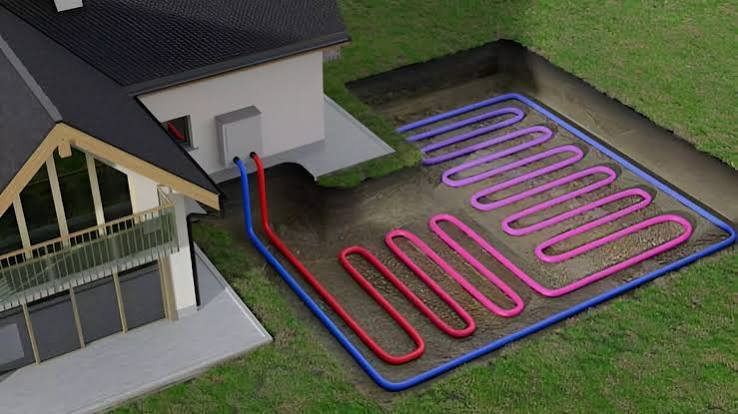
A geothermal system is a heat pump that exchanges heat with the ground rather than the outdoor air. Below a certain depth, soil temperature stays roughly constant year-round regardless of the weather above it. In winter the system extracts heat from that stable mass; in summer it rejects heat into it.
The advantage over an air-source heat pump is that a geothermal unit is not fighting a five-degree January morning. Its source temperature barely moves, so efficiency stays high in exactly the conditions that degrade air-source performance. It is also considerably quieter, since there is no outdoor fan unit.
Whether your lot qualifies
This is the first question, because it can end the conversation. Ground loops come in two broad configurations, and they have very different site requirements.
Horizontal loops are trenched several feet down across a wide area. They are less expensive to install but need substantial open land — this is a rural and large-suburban-lot solution, and it means excavating a meaningful portion of your yard. Mature trees, septic fields, and existing hardscape all constrain it.
Vertical loops are drilled in boreholes and need far less surface area, which makes them the practical option on typical suburban lots. They cost more because drilling costs more, and local geology matters: rock is slower and more expensive to drill through than soil. Access is also a genuine constraint, since a drilling rig has to physically reach the location.
Open-loop systems using a well are possible where groundwater conditions permit, but they carry permitting and water-quality considerations that vary considerably by jurisdiction.
The payback arithmetic
Installed cost is meaningfully higher than conventional equipment, with the ground loop representing much of the difference. Against that, operating costs are substantially lower, and the ground loop itself is long-lived — loop field life is generally measured in decades, well beyond the life of the heat pump equipment it serves.
That asymmetry is the core of the case. The expensive part lasts longest. When the indoor equipment reaches end of life, you replace the heat pump and keep the loop, so the second-generation cost is much closer to conventional.
Payback periods depend heavily on what you are replacing. Displacing electric resistance heat or propane produces the fastest return; displacing efficient natural gas produces the slowest, and in some cases the honest answer is that it does not pay back within a reasonable horizon. Anyone who quotes you a payback period without asking what you currently heat with is not calculating anything.
On incentives — verify, do not assume
Geothermal has historically attracted federal tax credits, state programs, and utility rebates, and those programs have changed repeatedly. Any specific percentage or dollar figure printed in an article has a real chance of being out of date by the time you read it, including in this one.
Check the current federal credit directly, check your state’s energy office, and check your utility’s residential program. Experienced geothermal heating and cooling contractors file these applications routinely and are a useful starting point, but confirm the figures yourself before you build them into a budget.
Who this is genuinely for?
Geothermal makes the most sense for homeowners who intend to stay in the house long enough to realize the operating savings, who are currently heating with something expensive, who have a site that accommodates a loop without excessive drilling cost, and who are replacing both heating and cooling at once so the incremental cost is measured against a full system rather than a repair.
If you are selling in five years, or you have cheap natural gas and a functional furnace, the arithmetic likely does not work — and a contractor who tells you that plainly is worth remembering for the project that does.