Streamlining Maritime Compliance with AI Technology
The Evolution of Digital Clearance in Global Shipping
Navigating the Panama Canal is a monumental feat of engineering, but for global shipping, it also represents a gauntlet of stringent compliance requirements. For fleet operators, ship agents, and charterers, ensuring a smooth transit through one of the world’s most vital waterways means mastering a complex digital ecosystem. In April 2026, with the Panama Canal Authority’s (ACP) increased automation, the margin for error has diminished significantly.
A single documentation oversight can trigger costly delays, substantial fines, and even the loss of a coveted transit slot – an operational nightmare. We understand the pressures involved in securing seamless passage through this critical maritime artery.
This comprehensive guide is designed to demystify the Ventanilla Única Marítima de Panamá, better known as VUMPA. We will delve into its critical requirements, the mandatory 96-hour submission deadline, and common pitfalls that lead to rejections. We’ll also cover essential elements like PCSOPEP and detailed cargo declarations.
We believe that leveraging advanced technology is key to mastering these complexities. Exploring how solutions, such as AI Panama Canal VUMPAapplications, can streamline compliance processes will be a central theme, offering insights into how to avoid penalties and ensure operational efficiency.
The Panama Canal, a marvel connecting the Atlantic and Pacific oceans, has always been at the forefront of global maritime trade. For over a century, it has facilitated the movement of goods, adapting to larger vessels and increasing traffic. However, with this growth came an escalating demand for efficient and secure administrative processes. Historically, vessel clearance involved a mountain of paperwork, requiring ship agents and operators to submit numerous forms to various Panamanian authorities. This manual, often redundant, system was prone to errors, delays, and inefficiencies, creating significant bottlenecks for vessels eager to transit.
Recognizing the need for modernization and alignment with international best practices, particularly the International Maritime Organization’s (IMO) push for Maritime Single Windows under the FAL Convention, Panama embarked on a journey towards digital transformation. The goal was to create a unified electronic platform that would streamline the exchange of information, reduce administrative burdens, and enhance the overall efficiency of maritime operations. This vision culminated in the development and implementation of VUMPA, Panama’s Maritime Single Window. This transition from a paper-laden past to a digitally integrated future represents a significant leap forward, not just for the Panama Canal Authority, but for the entire global shipping industry that relies on this vital artery. It transformed how vessels interact with the Canal, shifting the focus from physical documents to electronic data submissions, with the ultimate aim of accelerating transit times and bolstering security.
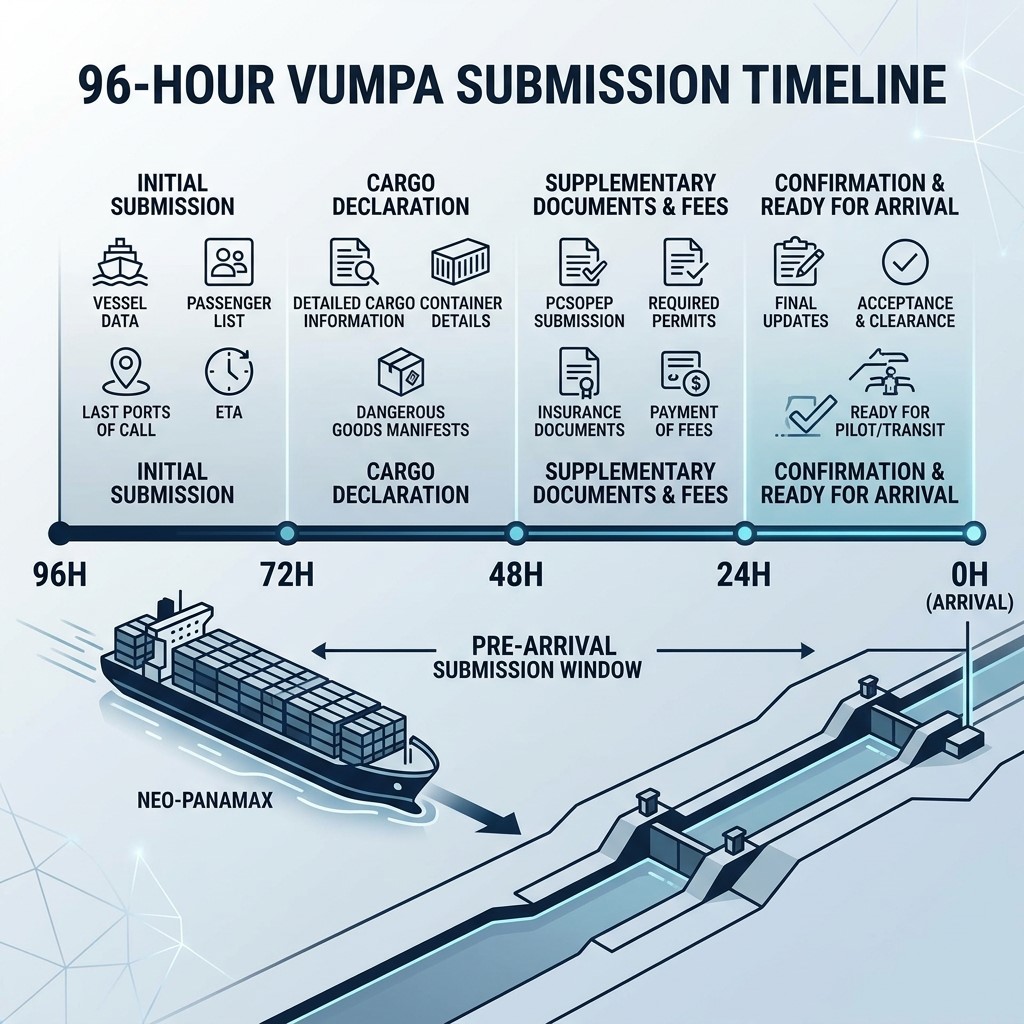
This evolution underscores a broader industry trend towards paperless operations, driven by both efficiency and environmental considerations. The move to digital clearance, while initially presenting a learning curve, ultimately promises a more predictable and less cumbersome process for all stakeholders. The stringent 96-hour VUMPA submission timeline, for instance, highlights the necessity of advance electronic data submission for comprehensive risk assessment and operational planning.
The Role of VUMPA in Modern Maritime Compliance Technology
VUMPA, which stands for Ventanilla Única Marítima de Panamá (Panama Maritime Single Window), is the cornerstone of Panama’s digital maritime compliance framework. It was conceived as a joint project between the Panama Canal Authority (ACP) and the Panama Maritime Authority (AMP), aiming to unify and simplify the electronic submission of vessel information for arrival, stay, and departure formalities. Instead of building an entirely new system, Panama wisely repurposed its existing Panama Canal Maritime Service Portal, expanding its capabilities to serve as the central hub for VUMPA.
The system officially began showing its benefits with the first ships arriving in September 2017, following a phased implementation that started on September 24th, 2017, for vessels operating in Panama Canal waters. Prior to this, the system had been in service since June 2015, but primarily for internal Panama Canal use. A significant update occurred in 2019, which brought improvements such as enhanced cargo declarations, more robust risk assessments, electronic fee payment capabilities, a clearer privacy policy, better document visualization, electronic alerts, and streamlined waste management procedures.
By April 2026, VUMPA has evolved into a highly automated system. The ACP portal now features full machine validation, meaning that every field and document within a submission is automatically checked against predefined rules and official databases. This automation has eliminated the previous manual review buffer, leading to immediate rejections for incomplete or inaccurate packages. The impact of VUMPA has been substantial: it was developed at a cost of $2 million and is predicted to save an impressive 3,200 to 3,260 hours annually for the maritime industry. Furthermore, it has eliminated more than 300,000 paper forms and documents, significantly reducing administrative overhead and contributing to CO2 emission reductions, as tracked by the Canal’s Green Connection rankings. VUMPA also facilitates crucial data sharing among various Panamanian government agencies, including the National Customs Authority and the National Immigration Service, ensuring a coordinated approach to vessel clearance.
Here’s a snapshot of VUMPA’s operational milestones:
- June 2015: Initial service for Panama Canal internal use.
- September 2017: Official launch and phased implementation for vessels in Panama Canal waters.
- November 2017: Full expansion of VUMPA functionality through the Panama Canal Maritime Service Portal.
- 2019: Major updates introducing electronic payments, enhanced risk assessments, and improved waste management.
- April 2026: Full portal automation with machine-level validation, eliminating manual review buffers and increasing scrutiny.
Streamlining First-Time Visitor Requirements
For vessels making their inaugural visit to Panama or those new to the VUMPA system, the platform streamlines what could otherwise be a complex onboarding process. Key steps include the issuance of a Customer Code, which identifies the operating entity, and the registration of a Ship Identification Number (SIN) for the vessel itself. Authorized shipping agencies play a crucial role here, acting as intermediaries to ensure all initial vessel admeasurement data is accurately captured and submitted. We recommend allowing a 2-3 business day buffer for new agent registration, especially before the critical 96-hour window for VUMPA submission opens, to prevent any last-minute delays.
Integration with Toll Estimation and Transit Bookings
VUMPA is not an isolated system; it seamlessly integrates with the ACP’s broader suite of maritime services, including toll estimation and transit booking. Operators can utilize the online toll calculator tool within the portal, which requires detailed vessel specifications such as PC/UMS (Panama Canal Universal Measurement System) tonnage, dimensions, and whether the vessel is in ballast or laden condition. This allows for accurate preliminary cost references. The system also handles requests for specific services like daylight transit booking and factors in loyalty categories (ranging from 0 to 4) that can influence charges. All these elements are governed by the established maritime tariffs and are increasingly integrated with the Enhanced Vessel Traffic Management System (EVTMS) for comprehensive operational planning.
Critical Documentation Pillars for Panama Canal Transit
Successful transit through the Panama Canal hinges on the meticulous preparation and submission of a comprehensive VUMPA package. In April 2026, the ACP’s fully automated portal performs machine-level validation across five main document categories. This means any discrepancy, no matter how minor, can lead to an outright rejection of the entire package, resulting in immediate slot forfeiture.
The five critical documentation pillars are:
- Vessel Particulars: Accurate and up-to-date information about the ship, including IMO number, tonnage, dimensions, and ownership details, precisely matching ACP records.
- Crew Credentials: A complete crew manifest with validated STCW endorsements for all officers.
- Equipment Certificates: All mandatory vessel certificates and equipment inspection reports, valid through the transit date.
- PCSOPEP: The Panama Canal Shipboard Oil Pollution Emergency Plan, if applicable, in its ACP-approved, bilingual format.
- Cargo Declaration: A precise declaration of all cargo, matching Bills of Lading, with additional details for dangerous goods.
The shift to automated validation marks a significant change from previous manual review processes:
Feature Manual Document Review (Pre-2026) 2026 Machine Validation (Current) Validation Process Human review by ACP staff; potential for discretion. Automated algorithms check against databases and rules; no discretion. Error HandlingMinor errors might be flagged for correction with a grace period. Immediate rejection for any discrepancy; no manual override. Speed Slower, dependent on staff availability and workload. Instantaneous validation; results provided immediately. ConsistencySubject to individual reviewer interpretation. Highly consistent, rule-based application. Rejection Impact Potential for delays, but often with a chance to rectify. Automatic slot forfeiture for rejected packages. Preparation Strategy Focus on general accuracy, allow for some back-and-forth. Absolute precision required; proactive, early preparation is critical. Validating Crew Credentials and STCW Compliance
The crew manifest is a pivotal component of the VUMPA submission. It must be complete, accurate, and include verifiable STCW (Standards of Training, Certification and Watchkeeping) endorsements for every officer on board. A common reason for VUMPA rejection is an expired STCW endorsement, even if it’s just by a single day. The 2026 portal automation performs real-time validation of these credentials. Beyond STCW, the manifest must be signed by the Master, and additional attachments such as crew effects declarations, vaccination lists, and bonded store declarations are required for vessel formalities.
Cargo Declarations and Dangerous Goods Protocols
Accuracy in cargo declarations is paramount. The information provided in VUMPA must precisely match the vessel’s Bills of Lading. For vessels carrying dangerous goods (DG), the requirements are even more stringent. A complete IMDG (International Maritime Dangerous Goods) classification must be provided. Special permits are required for Class 1 explosives and Class 7 radioactive materials, and these permits must be secured at least 10 days before the 96-hour VUMPA submission window opens. We’ve observed that lithium battery declarations (UN 3090, 3091, 3480, 3481) are increasingly common and frequently under-declared or incorrectly classified, leading to rejections. The 2026 system now includes advanced DG cross-validation and precautionary designators to flag potential risks.
Equipment Certificates and Vessel Readiness
A vessel’s readiness for Canal transit is certified through a suite of critical equipment certificates. These include the Safety Management Certificate (SMC), International Ship Security Certificate (ISSC), Load Line Certificate, and Minimum Safe Manning Certificate, among others. Crucially, all certificates must be valid through the transit date, not just the submission date. The ACP portal is designed to flag any certificate expiring within 30 days of the planned transit, triggering a rejection.
Beyond certificates, specific equipment requirements are rigorously enforced. Mooring line specifications are a key example: the ACP requires a minimum of six mooring lines, each at least 220 meters long, made of synthetic fiber (polypropylene, polyester, or nylon), in good condition, and meeting ACP minimum breaking load specifications for the vessel’s gross tonnage. Steel wire lines are not accepted. Substandard lines will delay transit until compliant replacements are sourced at the operator’s expense.
Ballast Water Management (BWM) is another critical area. All Canal transits are subject to IMO Ballast Water Management Convention enforcement. Vessels built after September 2017 must have an approved Ballast Water Treatment System (BWTS) meeting D-2 standards and present a valid Ballast Water Management Certificate and Ballast Water Record Book. Older vessels under D-1 exemptions must document open-ocean ballast exchange (200 nautical miles from land, 200 meters depth) in their BWRS before arriving at Canal approaches. ACP inspectors verify these records during pre-transit boarding. Furthermore, comprehensive MARPOL compliance, including up-to-date Oil Record Books, IOPP certificates, Garbage Management Plans, and Sewage Certificates, is routinely checked.
The Financial and Operational Risks of Non-Compliance
The stakes for VUMPA compliance are incredibly high. The 96-hour deadline for submission before a vessel’s arrival at the Canal anchorage (Balboa for the Pacific side, Cristóbal for the Atlantic side) is a hard cutoff with no grace period, regardless of weekends or technical issues. Missing this deadline results in automatic transit slot forfeiture, which can lead to severe financial penalties and operational disruptions. For a Neo-Panamax vessel, a slot forfeiture can translate to a daily operational loss of $65,000 or more. Slot reassignment typically requires a 72+ hour wait, compounding the costs significantly. Beyond slot loss, documentation violations can incur starting fines of $15,000 or more. Indeed, VUMPA filing errors are now the #1 cause of transit slot forfeiture, surpassing even weather delays or mechanical issues.
The ACP, as a member of the Acuerdo de Viña del Mar (Latin American PSC MOU), conducts rigorous Port State Control (PSC) inspections. They utilize a risk-based targeting model, not random checks, meaning vessels with prior issues or flagged by VUMPA are more likely to face detailed inspections. A detention at the Canal can trigger enhanced inspections at subsequent ports for up to 12 months, creating a ripple effect of compliance challenges.
Here are some of the most common reasons for VUMPA rejection in 2026:
- Tonnage Discrepancies: Any mismatch between declared tonnage (e.g., ITC, PC/UMS) and official ACP records.
- Expired STCW Endorsements: Even a single officer with an endorsement expired by one day will lead to rejection.
- Non-Bilingual PCSOPEP: PCSOPEP not provided in both English and Spanish, or an outdated/non-ACP approved version.
- Cargo Mismatches: Discrepancies between the cargo declaration and the Bill of Lading.
- Expiring Equipment Certificates:Any mandatory certificate valid for less than 30 days from the transit date.
PCSOPEP: Requirements for Persistent Oil Carriers
The Panama Canal Shipboard Oil Pollution Emergency Plan (PCSOPEP) is a critical document for specific vessels. It is mandatory for all vessels carrying 400 metric tons or more of persistent oil, whether as cargo (crude oil, heavy fuel oil) or as fuel (bunker fuel, lubricating oil). Notably, marine gas oil (MGO) and other distillate fuels do not count towards this threshold. The PCSOPEP must be ACP-approved, current, and provided in a bilingual format (English and Spanish). It must also be signed by the Master and specifically reference the Canal’s unique hydrological and environmental conditions, going beyond a standard SOPEP. Violations of PCSOPEP requirements carry a minimum fine of $50,000 and result in mandatory transit slot forfeiture. The plan also details various PCSOPEP tiers (ranging from NS to 5) and requires clear identification of authorized person (AP) contacts for emergency response.
Managing Departure Formalities and Zarpe Requests
VUMPA’s scope extends beyond arrival and transit to encompass departure formalities. The system requires port-specific reporting for both arrival and departure, ensuring a synchronized record of a vessel’s activities within Panamanian waters. Key requirements for departure include submitting waste disposal receipts, confirming all dues have been settled, and processing zarpe requests – the official clearance for a vessel to depart. The 2019 updates to VUMPA introduced electronic payment of government fees via debit/credit cards, further streamlining this process. The system facilitates automated clearance distribution to all relevant authorities, ensuring a swift and efficient departure.
Leveraging AI for Automated VUMPA Submissions
The complexity and high stakes associated with VUMPA submissions in April 2026 make manual processes increasingly risky and inefficient. This is where advanced solutions, particularly those leveraging artificial intelligence, offer a transformative advantage. We advocate for a proactive, technology-driven approach to compliance, starting with a 10-day preparation strategy, well in advance of the hard 96-hour deadline. This extended lead time allows for thorough data compilation, verification, and the necessary buffer to address any potential issues identified by automated systems.
The ACP’s shift to machine-level validation means that software, not humans, is now the first line of defense against non-compliance. This makes an AI-powered solution for AI Panama Canal VUMPAsubmissions not just beneficial, but almost essential for reliable transit. Such platforms are designed to navigate the intricacies of VUMPA, mitigating the risks of human error and ensuring submissions are flawless.
Integrating AI into Maritime Compliance Technology
AI-driven compliance platforms integrate seamlessly with a vessel’s existing data, performing sophisticated checks that far exceed manual capabilities. They excel at document ingestion, automatically extracting key information from certificates, manifests, and other forms. Crucially, they perform extensive data cross-referencing against official databases and the ACP’s specific requirements, identifying inconsistencies that a human might miss. This includes automated portal population, reducing the laborious task of manual data entry.
One of AI’s most powerful applications in VUMPA is its ability to detect tonnage mismatches, a frequent cause of rejection. It can also monitor certificate expiry dates, flagging documents that will become invalid within the ACP’s critical 30-day window from the transit date. For PCSOPEP, AI can verify the plan’s version, ensure it’s ACP-approved, and confirm its bilingual status. Furthermore, AI tools can cross-validate dangerous goods classifications against cargo declarations and Bills of Lading, catching subtle errors that could lead to severe penalties. Fleets utilizing AI-assisted VUMPA preparation have reported over 80% reductions in transit slot forfeitures due to documentation errors, and have dramatically cut preparation time from 6-10 hours of skilled agent time to under 15 minutes per vessel.
Reducing Paperwork and Inspection Times
VUMPA’s initial objective was to reduce paperwork and inspection times by facilitating a single inspector protocol and automating risk assessments. By eliminating more than 300,000 paper forms and saving thousands of hours annually, VUMPA has already made significant strides. AI amplifies these benefits. By ensuring that all electronic submissions are accurate and complete, AI-powered systems contribute to smoother pre-arrival risk assessments, leading to fewer on-board inspections and faster clearance processes. Electronic alerts keep operators informed, and integrated waste management tracking further streamlines environmental compliance. The synergy between VUMPA’s digital framework and AI’s analytical power creates an ecosystem where operational efficiency and compliance are not just goals, but achievable realities.
Frequently Asked Questions about Panama Canal VUMPA
Understanding the nuances of VUMPA is crucial for smooth transit. Here, we address some of the most common questions from operators.
What is VUMPA and what does the acronym stand for?
VUMPA stands for Ventanilla Única Marítima de Panamá, which translates to Panama Maritime Single Window. It is an electronic platform developed as a joint project between the Panama Canal Authority (ACP) and the Panama Maritime Authority (AMP). Its primary purpose is to streamline and centralize the submission of pre-arrival notifications and formalities for all vessels calling at or transiting through Panamanian waters, replacing traditional paper-based processes.
What is the 96-hour deadline for VUMPA submission and how is it calculated?
The 96-hour deadline is a strict requirement for VUMPA submission. It means that the complete VUMPA package must be successfully filed via the ACP Maritime Service Portal at least 96 hours before your vessel’s scheduled arrival at either the Balboa (Pacific side) or Cristóbal (Atlantic side) anchorage. This is a hard cutoff with no grace period, and it applies irrespective of weekends or public holidays. We strongly recommend beginning your document preparation and submission process at least 10 days in advance to allow for any unforeseen issues or necessary rectifications.
What are the most common reasons for VUMPA rejection in 2026?
In the highly automated VUMPA system of 2026, even minor discrepancies can lead to outright rejection and slot forfeiture. The most common reasons include:
- Tonnage Discrepancies: Any mismatch between the declared vessel tonnage (e.g., ITC, PC/UMS) and the official records held by the ACP.
- Expired STCW Endorsements: An officer’s STCW endorsement that is expired, even by a single day, will trigger a rejection.
- Non-Bilingual PCSOPEP: For applicable vessels, the PCSOPEP must be provided in both English and Spanish, be ACP-approved, and be the current version.
- Cargo Mismatches: Inconsistencies between the cargo declaration submitted in VUMPA and the vessel’s Bills of Lading.
- Expiring Equipment Certificates:Any mandatory vessel certificate that is valid for less than 30 days from the vessel’s planned transit date.
Conclusion: The Future of Autonomous Maritime Compliance
The Panama Canal stands as a testament to human ingenuity, and its digital transformation through VUMPA is a continuation of that legacy. The system, particularly with its 2026 automation, represents a critical step towards enhancing operational efficiency, ensuring maritime safety, and promoting environmental sustainability. By centralizing data, reducing paperwork, and enforcing rigorous compliance standards, VUMPA has profoundly reshaped how vessels interact with this vital waterway. For operators, embracing these digital tools is no longer optional; it is fundamental to securing seamless, penalty-free transits.
The journey towards autonomous maritime compliance is far from over. As technology continues to advance, we anticipate even greater integration and sophistication in systems like VUMPA.
Future Trends in Maritime Compliance Technology
Looking ahead, the maritime industry can expect several key trends to shape the future of compliance technology:
- Advanced Machine Learning Validation: Further refinement of AI algorithms to predict potential compliance issues even before submission, offering proactive solutions.
- Real-Time Regulatory Updates:Integration of systems that automatically update with the latest international and local regulations, ensuring continuous compliance.
- Autonomous Vessel Clearance: As autonomous shipping advances, compliance systems will evolve to handle automated data exchange directly from vessel to port authority, potentially leading to fully autonomous clearance processes.
- Global Single Window Standardization: A continued push for greater interoperability and standardization among national maritime single windows, reducing complexity for global fleets.
The goal is to create a fully integrated, intelligent maritime ecosystem where compliance is seamless, efficient, and predictive, ensuring that the world’s oceans remain open and accessible for trade, while upholding the highest standards of safety and environmental protection.